



Urgent care moves fast your revenue cycle should too. But most clinics feel trapped in the same cycle: unpredictable patient volume, complex payer rules, and constant coding changes that slow down reimbursement.
- Running an urgent care clinic is like managing two businesses at once.
- On one side: nonstop walk-ins for fevers, fractures, infections, and weekend rushes.
- On the other hand, a billing process can collapse from a single missing modifier, incorrect POS code, or an outdated payer guideline.
And when the front desk is overwhelmed, errors follow—creating the familiar pattern:
More visits → More errors → More denials → More payment delays.
The good news? With streamlined workflows, clean documentation, accurate coding, and the right RCM partner, urgent care clinics can turn chaos into consistent cash flow.
In this blog, we will explore how CodeCure’s tech-powered RCM services help clinics get paid faster with fewer administrative headaches.
What Is an Urgent Care Facility?
Urgent care clinics fill the critical gap between primary care providers and emergency departments. They handle non-life-threatening medical needs that require immediate attention; no appointment is needed.
According to the Urgent Care Association (UCA), the U.S. has over 11,000 urgent care centers, with high concentrations in Texas, California, Florida, New York, and Georgia. These centers serve a mix of:
- Orthopedic walk-ins
- Respiratory infections
- Occupational medicine
- Pediatrics
- Minor injuries & lacerations
- Chronic condition flare-ups
- Flu, RSV, and COVID spikes (seasonal surges)
The CMS definition is simple: urgent care is unscheduled, immediate ambulatory care delivered outside of hospital ERs and routine doctors’ offices.
And because of this unique care model, the billing rules are also unique.
Basics of Urgent Care Billing (And Why It’s More Complicated Than It Looks)
Urgent care billing involves several components that directly affect reimbursement:
1. Facility Fees
Urgent cares often charge a facility fee to cover extended hours, equipment, clinical staff, and overhead.
2. Point-of-Service Collections
Clinics typically collect:
- Co-pays
- Co-insurance
- Deductibles
- Self-pay payments
Collecting at the front reduces bad debt and improves cash flow instantly.
3. Multiple Payer Types
Urgent care billing includes:
- Private commercial plans
- State Medicaid plans
- Medicare Part B
- Workers’ compensation
- Employer contracts
- Self-pay / cash visits
Each has different reimbursement rules, and discrepancies are a major cause of denials.
4. Documentation & Coding
Urgent care providers must support every claim with:
- Proper ICD-10 codes
- Detailed clinical documentation
- Accurate CPT/E/M levels
- Proper procedure codes
- Correct modifiers
A single missing detail can turn into a denied claim.
Place of Service (POS) Codes in Urgent Care Billing
The correct POS code is crucial. The main one for urgent care is:
| POS Code | Description / When It’s Used | Impact |
| POS 20 | Urgent Care Facility | Primary POS for urgent care; used for unscheduled, immediate-care visits. |
| POS 11 | Office | Some payer contracts require POS 11 even for urgent care services. |
| POS 23 | Emergency Room | Used for freestanding emergency departments, not typical urgent care centers. |
Why POS Code Accuracy Matters
| Issue Caused by Wrong POS Code |
|
|
|
CodeCure Insight:
Incorrect POS coding is one of the top denial trends we see when onboarding new urgent care clients.
Insurance and Urgent Care Reimbursement: Medicare, Medicaid & Commercial Plans
Urgent care reimbursement varies significantly by payer type and this is where most clinics experience the biggest delays.
Medicare Billing for Urgent Care
Medicare does not recognize urgent care S-codes (S9083, S9088).
Medicare follows:
- E/M codes
- Procedure codes
- Typical outpatient billing rules
Once the deductible is met, Medicare generally pays 80%, with the remaining 20% patient responsibility.
Medicaid Billing for Urgent Care
Medicaid programs vary state-by-state. For example:
- Texas, Georgia, and Florida Medicaid require strict POS and diagnosis coding accuracy.
- New York Medicaid often has additional visit authorization rules.
- California Medi-Cal requires accurate provider enrollment for coverage.
Medicaid often reimburses lower than Medicare or commercial, but it still covers medically necessary urgent care visits.
Commercial Insurance (Private Payers)
Commercial plans typically offer faster reimbursement and higher rates, BUT they have strict rules:
- Some require the S9088 add-on codes
- Some use S9083 global encounter codes
- Others reject both and require standard E/M codes only
Understanding each contract’s requirements is key.
Common Codes Used in Urgent Care Billing
Urgent care codes fall under four main categories:
| Category | Code(s) | Description |
| ICD-10 Diagnosis Codes | J06.9 | Acute upper respiratory infection |
| S80.811A | Knee abrasion | |
| B34.9 | Viral infection, unspecified | |
| E/M Visit Codes | 99202–99205 | New patient visits |
| 99211–99215 | Established patient visits | |
| Urgent Care-Specific Codes | S9088 | Urgent care services add-on |
| S9083 | Global urgent care encounter (case-rate) | |
| Procedure Codes | 12002 | Laceration repair |
| 10060 | Abscess drainage | |
| 29105 | Splint application | |
| 87804 | Rapid flu test | |
| 71046 | Chest X-ray |
Documentation Requirements
| Required Elements for Clean Claims |
|
|
|
Avoiding Common Urgent Care Billing Denials
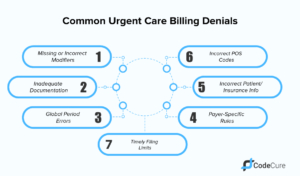
Urgent care clinics see up to a 21–35% denial rate nationally, depending on the state. Denials are highest in:
- Florida (due to managed care plans)
- Texas (due to Medicaid MCO rules)
- California (due to strict documentation requirements)
Major billing pitfalls include:
1. Missing or Incorrect Modifiers
Especially modifier-25 with E/M + procedure.
2. Inadequate Documentation
If the note doesn’t match the billed code, the claim will be denied.
3. Global Period Errors
Follow-up visits after procedures must be coded correctly.
4. Incorrect POS Codes
Wrong POS = automatic denial.
5. Incorrect Patient/Insurance Info
Front-desk errors create 40% of claim rejections nationwide.
6. Payer-Specific Rules
Every payer has unique rules, especially commercial plans.
7. Timely Filing Limits
Most urgent cares lose 8–12% of revenue due to missed filing deadlines.
Why Urgent Care Billing Requires a Specialized RCM Partner
Urgent care billing is different from primary care billing, ER billing, and specialty billing. The walk-in model means:
- High patient volume
- Seasonal spikes
- Multiple payer types
- Many minor procedures
- Rapid decision-making
- Tight documentation requirements
It requires:
- Speed
- Accuracy
- Coding expertise
- State-based compliance knowledge
- Payer contract understanding
- Tech to reduce administrative tasks
This is where CodeCure makes the biggest impact.
How CodeCure Helps Urgent Care Clinics Get Paid Faster
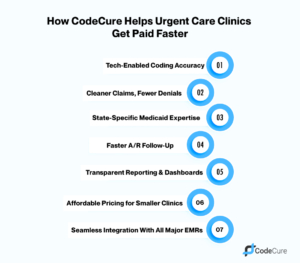
CodeCure combines affordable pricing, high-quality billing support, and tech-enabled automation to simplify urgent care billing without overwhelming clinics with complexity.
Here’s how CodeCure improves your revenue cycle:
1. Tech-Enabled Coding Accuracy
CodeCure uses automated code-scrubbers, AI-driven documentation review, and payer-specific rules to reduce errors before claims go out.
2. Cleaner Claims, Fewer Denials
Claims are validated for POS accuracy, modifiers, procedures, and urgent-care-specific rules reducing rejections.
3. State-Specific Medicaid Expertise
From Texas TMHP to New York Medicaid to California Medi-Cal—CodeCure knows the differences.
4. Faster A/R Follow-Up
Intelligent routing ensures unpaid claims get escalated faster.
5. Transparent Reporting & Dashboards
CodeCure provides analytics on:
- Denial trends
- Payer performance
- Cash flow
- Collections
- Visit volume
- Coding patterns
6. Affordable Pricing for Smaller Clinics
You get premium-level expertise without enterprise-level pricing.
7. Seamless Integration With All Major EMRs
Including:
- Athena
- eClinicalWorks
- Epic (urgent care modules)
- AdvancedMD
- Experity
- NextGen
- DrChrono
- Tebra
CodeCure adapts to your workflow not the other way around.
Why Clinics Choose CodeCure Over Other Billing Services
Urgent care providers prefer CodeCure for three reasons:
Affordable for small & mid-size centers
Budget-friendly without compromising quality.
High-quality billing + coding accuracy
Urgent care specialists handle your claims.
Tech-powered efficiencies
Automation + human expertise = faster reimbursement.
Conclusion
Urgent care billing is complex, fast-paced, and constantly changing. Between payer-specific rules, strict documentation requirements, seasonal patient surges, and coding demands, even experienced clinics struggle with denials and delayed payments.
With the right billing partner, one that combines affordability, accuracy, and tech innovation, urgent care clinics can reduce denials, improve cash flow, and stay focused on patient care.
CodeCure doesn’t just manage billing.
It stabilizes your revenue cycle, strengthens your operations, and helps your urgent care grow—without the administrative chaos.
FAQs
Why do urgent care claims get denied so often?
Urgent care claims are frequently denied due to missing modifiers, incorrect POS codes, incomplete documentation, or rapid payer policy changes.
What insurance plans do urgent care centers struggle with the most?
Medicare, Medicaid, and large commercial payers (BCBS, Aetna, UHC) often cause delays due to strict guidelines and high documentation requirements.
How can urgent care clinics reduce claim denials?
Clean documentation, correct CPT/ICD-10 coding, accurate insurance verification, and consistent use of urgent-care-specific modifiers significantly reduce denials.
How does CodeCure help urgent care clinics get paid faster?
CodeCure streamlines credentialing, manages enrollment, fixes coding errors, reduces denials, and automates billing workflows so clinics see faster, more predictable reimbursements.