



Chiropractic credentialing is the formal process that allows a chiropractor to become approved by insurance companies, Medicare, and Medicaid to bill for covered services. It is the administrative foundation that determines whether a chiropractor can legally participate in insurance networks and receive reimbursement.
Many chiropractors focus on patient care, treatment protocols, and practice growth strategies. However, without proper credentialing, even the most successful clinical practice cannot generate insurance revenue. Claims submitted without approved enrollment are denied automatically, and in many cases, reimbursement cannot be retroactively recovered.
Credentialing is not simply paperwork. It is a structured verification and enrollment system that directly affects cash flow, compliance status, and long-term financial stability.
This guide explains chiropractic credentialing in depth, including how the process works, how long it takes, common mistakes, Medicare requirements, Medicaid differences, commercial insurance enrollment, recredentialing obligations, and how credentialing impacts the overall revenue cycle.
What is Chiropractic Credentialing?
Chiropractic credentialing is the process by which insurance payers verify that a chiropractor meets all professional, regulatory, and compliance standards required for network participation.
Insurance companies evaluate multiple factors before approving coverage. These include verification of state licensure, malpractice insurance coverage, educational background, professional work history, federal exclusion status, and practice location validation. For Medicare and Medicaid participation, additional federal and state-specific requirements apply.
Credentialing ensures that a chiropractor:
- Holds an active and unrestricted state license
- Maintains valid malpractice insurance
- Has no active federal exclusions
- Meets payer-specific eligibility requirements
- Operates from a verified and compliant practice location
Once credentialing is approved, the chiropractor is considered in-network and can submit claims in accordance with the payer’s reimbursement policies.
It is important to distinguish credentialing from contracting. Credentialing confirms eligibility to participate in a network. Contracting determines reimbursement rates, fee schedules, and participation terms. Both processes must be completed correctly for a chiropractor to receive payment.
Why Credentialing Is Essential for Chiropractic Revenue
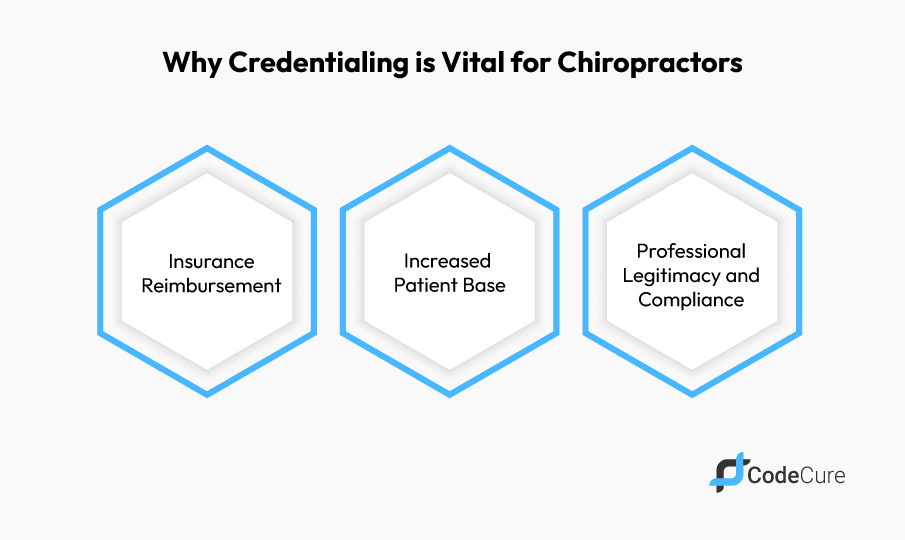
Credentialing directly influences the financial health of a chiropractic practice. Without approved enrollment, insurance claims are rejected at the clearinghouse or payer level. Even when services are properly documented and medically necessary, reimbursement cannot occur without active credentialing status.
Delayed enrollment often leads to delayed cash flow. In some cases, insurance carriers allow limited retroactive billing if enrollment is approved. However, this is not guaranteed and varies by payer. If retroactive billing is denied, revenue for services already provided may be permanently lost.
Consider a chiropractic clinic that averages $50,000 per month in insurance collections. If credentialing is delayed for three months, the practice may face $150,000 in delayed or unrecoverable claims exposure. This directly affects payroll, rent, staffing, and operational planning.
Credentialing also affects patient growth. Many patients search specifically for in-network providers. Without proper enrollment, a chiropractor may not appear in insurance directories, which limits referral opportunities and new-patient volume. From a compliance standpoint, billing insurance without proper credentialing can trigger audits, repayment demands, and contract termination. Credentialing is therefore both a financial and regulatory safeguard.
Types of Chiropractic Credentialing
| Credentialing Type | Who It Covers | Enrollment Platform / Forms | Key Requirements | Processing Timeline | Important Notes |
|---|---|---|---|---|---|
| Medicare Enrollment | Chiropractors treating Medicare beneficiaries (primarily patients age 65+) | PECOS system; CMS-855I (individual), CMS-855B (group practices) | Active state license, NPI, malpractice insurance, ownership disclosures, reassignment of benefits (if applicable) | Typically 60–90 days | Required to bill Medicare for covered spinal manipulation services; periodic revalidation mandatory; improper or incomplete enrollment results in automatic claim denials |
| Medicaid Credentialing | Chiropractors serving Medicaid patients (varies by state eligibility rules) | State-specific Medicaid portals and forms | State license verification, malpractice coverage, ownership disclosure, possible background checks, fingerprinting, site visits | 45–120+ days depending on state | Each state has unique requirements; multi-state providers must enroll separately in each state; often more administratively complex than Medicare |
| Commercial Insurance Credentialing | Chiropractors participating in private insurance networks (BCBS, Aetna, UHC, Cigna, regional PPOs) | Payer-specific applications; CAQH ProView profile required by most carriers | Completed and attested CAQH profile, license verification, malpractice documentation, work history, practice location validation | 30–90 days depending on payer | Some networks may have closed panels; reimbursement rates are determined during contracting phase after credentialing approval |
Workers’ Compensation Enrollment
Workers’ compensation enrollment enables chiropractors to treat patients with job-related injuries under their state’s regulated workers’ compensation system. Because these programs are administered at the state level, requirements vary and may include separate registration portals, carrier approvals, certifications and adherence to state-specific treatment guidelines. Proper enrollment and compliance are essential to ensure timely reimbursement and avoid claim denials.
The Complete Chiropractic Credentialing Checklist
Chiropractic credentialing is not a single submission but a continuous process that ensures providers can legally bill insurance and maintain network participation. Each phase requires accurate documentation and monitoring to prevent delays, denials, or compliance issues. Alignment across federal, state, and private payer systems is critical for smooth revenue flow.
1. Initial Application
The process begins with the initial application, where chiropractors gather all essential documentation,
Documentation includes:
- Active chiropractic license
- Malpractice insurance face sheet
- W-9 form
- NPI confirmation
- Driver’s license
- Work history (5 years)
- Board certification (if applicable)
- Voided check for EFT enrollment
Accuracy here sets the foundation for approval. Mistakes at this stage can delay enrollment for weeks or even months.
2. CAQH Profile Creation and Attestation
Most commercial insurance carriers use CAQH ProView to verify provider information.
A complete CAQH profile must include:
- Education history
- Practice locations
- Hospital affiliations
- Liability coverage
- Attestation every 120 days
Attestation of this information is required every 120 days. An outdated or unattested CAQH profile is one of the most common causes of credentialing delays.
3. Medicare PECOS Registration
Chiropractors must enroll through PECOS (Provider Enrollment, Chain, and Ownership System).
Required steps include:
- NPI Type 1 registration
- Tax ID verification
- CMS-855I individual enrollment
- CMS-855B group enrollment (if applicable)
- Reassignment of benefits
- EFT (CMS-588) submission
Failure to properly enroll in Medicare results in automatic claim denials. PECOS captures ownership, practice information, and reassignment of benefits. Approval allows Medicare billing, but ongoing monitoring is needed for revalidation to prevent deactivation.
4. Medicaid Credentialing (State- Specific)
Medicaid enrollment varies by state.
Common requirements:
- State license validation
- Background checks
- Fingerprinting (in some states)
- Site visits
- Provider portal registration
Processing time varies widely (45–120+ days). Some states also require background checks or site visits. Multi-state practices must complete separate enrollments in each jurisdiction.
5. Commercial Payer Submissions
Enrollment with private insurers such as Blue Cross Blue Shield, UnitedHealthcare, or Aetna requires a separate application for each payer, even if CAQH is used for verification. After approval, the contracting phase determines reimbursement rates and participation terms. Approval timelines range from 30 to 90 days, depending on payer backlog and documentation accuracy.
6. EFT and ERA Setup
Once credentialed, chiropractors set up Electronic Funds Transfer (EFT) for direct payment deposits and Electronic Remittance Advice (ERA) for claim reconciliation. These systems streamline payment posting and reduce administrative workload.
7. Recredentialing Every 2-3 Years
Most payers require providers to recredential every 2–3 years. This ensures licensure, insurance coverage, and compliance remain current. Missing deadlines can lead to suspension or termination from insurance networks.
8. Medicare Revalidation
Medicare providers must periodically revalidate enrollment information through PECOS. Failure to respond on time can deactivate billing privileges, requiring full reenrollment to restore access.
9. Database Alignment and Monitoring
Throughout the lifecycle, all information must be consistent across CAQH, the NPI registry, IRS records, payer systems, and state databases. Even small inconsistencies can trigger delays or claim denials. Regular monitoring of applications, renewals, and revalidations is critical to maintaining uninterrupted revenue flow.
CAQH Role in Chiropractic Credentialing
CAQH ProView plays a critical role in chiropractic credentialing by serving as a centralized database that insurers rely on to verify provider information. Even when all documentation is complete, delays or errors often occur if the CAQH profile is outdated or not properly maintained. Accurate and regularly updated CAQH information ensures alignment across NPI records, IRS documentation, and payer systems, preventing credentialing interruptions, claim denials, and recredentialing delays. Effectively managing CAQH profiles helps chiropractors maintain continuous network participation and secure timely insurance reimbursements.
Common Chiropractic Credentialing Mistakes
Even small errors in the credentialing process can cause major delays, denied claims, and lost revenue. Some of the most frequent mistakes include:
-
Inconsistent Practice Information Across Systems
Even small differences in practice addresses or formatting between IRS records, NPI registration, and payer applications can trigger manual reviews. These discrepancies often delay approvals and slow down the overall credentialing process, potentially holding up claim submissions for weeks. -
Outdated or Missing Malpractice Insurance Documentation
Failure to maintain current malpractice insurance records in CAQH or other payer portals is a common mistake. Incomplete documentation can result in applications being suspended or denied, requiring providers to resubmit forms and delaying network enrollment. -
Submitting the Wrong CMS Form for Medicare Enrollment
Some chiropractors accidentally select the wrong CMS-855I (individual) or CMS-855B (group) form when enrolling with Medicare. This error results in outright rejection of the application and requires resubmission, adding unnecessary time and administrative burden. -
Ignoring Medicare Revalidation Notices
Medicare periodically requires providers to revalidate their enrollment information. Failure to respond on time can result in the deactivation of billing privileges. Restoring access requires a full re-enrollment, which can result in months of lost revenue. -
General Documentation Errors
Even minor errors in dates, license numbers, or certification details can delay credentialing. Insurance carriers often reject incomplete or inconsistent submissions, creating a backlog that affects cash flow and practice operations.
These common mistakes highlight the importance of accuracy, timely updates, and careful monitoring throughout the credentialing process. Avoiding them ensures faster approvals, uninterrupted billing, and steady revenue flow.
Group vs. Individual Credentialing Structures
Credentialing requirements differ depending on whether you practice solo or as part of a group; the table below highlights the key differences and considerations for each structure.
| Feature | Solo Practitioner Credentialing | Group Practice Credentialing |
|---|---|---|
| NPI Requirement | Individual NPI only | Individual NPI for each provider and a group NPI for the organization |
| Documentation | Submitted under the provider’s personal credentials | Each provider submits personal documents; group documents are submitted for organization |
| Reassignment of Benefits | Simple: payments routed directly to the individual | Must be properly documented to ensure payments go to the group or designated provider |
| Multi-Location Practices | Not applicable | Must maintain consistent addresses, tax records, and licensing across all locations |
| Credentialing Complexity | Relatively straightforward | More complex; increases with number of providers and locations |
| Monitoring & Maintenance | Individual tracking required | Centralized management recommended to prevent lapses or errors |
| Impact on Revenue | Single source of reimbursement | Errors in group credentialing can delay payments for multiple providers |
Recredentialing and Ongoing Maintenance
Most insurance carriers require chiropractors to recredential every two to three years to confirm that licensure, malpractice insurance, and compliance standards remain current. Medicare also requires periodic revalidation, and failure to complete it by the required deadline can result in deactivation of billing privileges and a temporary loss of reimbursement. Consistent monitoring and proactive maintenance of all credentialing information are essential to ensure uninterrupted network participation, prevent claim denials, and maintain steady revenue flow.
When Should Chiropractors Begin Credentialing?
Chiropractors should begin the credentialing process 90 to 120 days before opening a new practice or onboarding a new provider. Starting early gives ample time to gather and review all required documents, submit applications accurately, and allow for payer processing, which can often take weeks. Waiting until patients are already scheduled can create billing gaps, delayed reimbursements, and unnecessary financial stress. By planning ahead, practices can ensure a smooth start, uninterrupted revenue, and timely access to insurance networks.
Streamline Your Practice Enrollment and Recredentialing with CodeCure
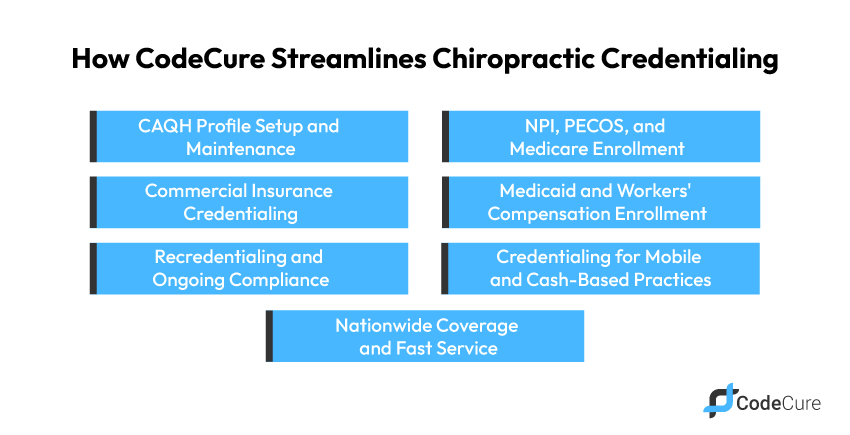
At CodeCure, we simplify every aspect of chiropractic credentialing so your practice remains compliant, in-network, and ready to receive timely reimbursements. Our services cover the full credentialing lifecycle, ensuring accuracy, speed, and ongoing compliance.
-
CAQH Profile Setup and Maintenance
We create and manage your CAQH profile, including document uploads, attestations, and quarterly re-attestation reminders. Keeping your profile accurate and up-to-date helps prevent application delays, denials, and disruptions in payer approvals. -
NPI, PECOS, and Medicare Enrollment
CodeCure handles NPI Type 1 and Type 2 registration, Medicare PECOS enrollment, revalidation, and Medicare Advantage alignment. We ensure your practice meets all Medicare requirements, reducing the risk of claim denials, especially in high-volume states. -
Commercial Insurance Credentialing
We manage enrollment with major commercial insurers such as Blue Cross, Aetna, and UnitedHealthcare. By ensuring your credentials are complete and accurate, we help you expand your patient base and maintain eligibility for insured patients. -
Medicaid and Workers’ Compensation Enrollment
Our team handles Medicaid and workers’ compensation credentialing, navigating state-specific requirements to ensure your practice is fully compliant and able to receive reimbursement under these programs. -
Recredentialing and Ongoing Compliance
CodeCure oversees recredentialing every 2–3 years, ensuring that all licenses, certifications, and payer documents remain current. This proactive approach prevents network termination and maintains uninterrupted revenue. -
Credentialing for Mobile and Cash-Based Practices
We assist mobile and cash-based practices in expanding into insurance networks, ensuring a smooth transition while avoiding common credentialing errors and delays. -
Nationwide Coverage and Fast Service
With nationwide reach, CodeCure streamlines the credentialing process, reducing delays and speeding approvals. Our expert team provides guidance at every step to ensure your practice remains compliant and fully reimbursable.
Conclusion
Credentialing is a critical process that every chiropractor must navigate to ensure insurance reimbursement and maintain a steady revenue stream. While credentialing can be a complex and ongoing task, it doesn’t have to overwhelm your practice. With the right partner, you can stay credentialed, remain in-network, and maximize your reimbursement opportunities, allowing you to focus on delivering exceptional care to your patients.
If you need help with credentialing or recredentialing, contact CodeCure today. We’ll simplify the process and help your practice grow.
FAQs:
What is chiropractic credentialing?
Chiropractic credentialing is the process of verifying a chiropractor’s qualifications, licensure, and compliance to allow participation in insurance networks, Medicare, and Medicaid. It ensures you can legally bill for covered services.
Why is credentialing important for my practice?
Without credentialing, insurance claims are denied, reimbursements are delayed, and your patient base is limited. Proper credentialing ensures steady revenue, compliance, and network participation.
How long does chiropractic credentialing take?
What is a CAQH profile and why do I need it?
CAQH ProView is a centralized database for commercial insurers. Maintaining an updated profile with licensure, insurance, and work history prevents credentialing delays and claim denials.
Can I start billing insurance before credentialing is complete?
No. Submitting claims without approved credentialing leads to automatic denials and potential compliance issues. Credentialing must be completed before billing.
How often do chiropractors need to recredential?
Most insurers require recredentialing every 2–3 years. Medicare also requires periodic revalidation through PECOS to maintain billing privileges.
Can I outsource chiropractic credentialing?
Yes. Credentialing services like CodeCure handle CAQH setup, Medicare/Medicaid enrollment, commercial insurance submissions, and ongoing maintenance, saving time and reducing errors.