


Orthopedic Medical Billing is a major challenge for many practices, as over 30% of claims are denied due to coding errors and slow reimbursements can leave your practice struggling to maintain cash flow. Complex procedures, frequent denials, and compliance headaches only add to the stress. With the right billing solution, you can tackle these issues head-on, reduce claim denials by up to 40%, and optimize your revenue cycle to keep your practice financially healthy.
What is Orthopedic Medical Billing?
Orthopedic medical billing involves the submission and management of claims related to orthopedic services. These services can range from joint replacement surgeries and physical therapy to fracture treatments and imaging. Unlike general medical billing, orthopedic billing requires specialized knowledge of complex codes such as ICD-10, CPT, and HCPCS.
Given the complexity of orthopedic procedures, accurate and timely billing is vital for ensuring proper reimbursement. An optimized orthopedic billing solution is essential for maximizing revenue and minimizing errors, reducing the administrative burden, and improving cash flow.
Challenges in Orthopedic Medical Billing
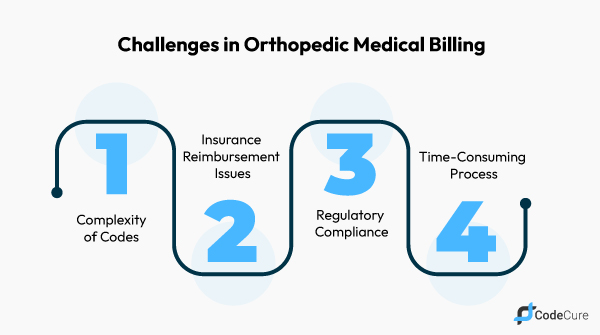
Orthopedic practices often face unique challenges in the billing process. Understanding these obstacles highlights the importance of a specialized billing solution:
1. Complexity of Codes
Orthopedic procedures require precise coding. From knee arthroscopy to spinal surgeries, using the correct codes is crucial. Errors in coding can result in claim denials, leading to delayed payments and increased administrative work.
2. Insurance Reimbursement Issues
Orthopedic practices deal with multiple insurance providers, each with its own set of reimbursement rules. Navigating these varied requirements can be time-consuming and error-prone, especially when minor mistakes lead to claim rejections.
3. Regulatory Compliance
The constant evolution of healthcare regulations, such as HIPAA and CMS guidelines, requires orthopedic practices to stay updated. Failure to comply can result in penalties and billing errors, affecting the overall revenue.
4. Time-Consuming Process
Billing for orthopedic services is time-intensive. Practices must verify insurance eligibility, submit claims, follow up on denials, and manage patient payments. This process can overwhelm smaller practices that lack dedicated billing staff.
Common CPT Cheat Codes in Orthopedic Medical Billing
Accurate CPT coding is essential for ensuring quick reimbursement in orthopedic practices. Below is a quick reference table of frequently used codes, along with billing tips to reduce denials and improve revenue cycle management:
| Service | CPT Code | Billing Tip |
| Knee Arthroscopy with Meniscectomy | 29881 | Ensure clear documentation of the type of meniscectomy (partial or complete) and the specific knee area treated. Use modifiers if performed with another procedure. |
| Knee Arthroplasty (Total Knee Replacement) | 27447 | Specify whether the procedure is primary or revision. Use the appropriate modifier if the procedure is performed with other services. |
| Spinal Fusion Surgery (Anterior Approach) | 22554 | Document the number of levels fused and the type of fusion (e.g., interbody, posterolateral). Ensure the right approach (anterior, posterior, or lateral). |
| Hip Replacement (Total Hip Arthroplasty) | 27130 | Be specific about the type of prosthesis used (e.g., cemented vs. uncemented). Consider using a modifier for bilateral procedures. |
| Fracture Treatment, Closed | 27506 | Specify the type of fracture (e.g., simple, comminuted). Ensure accurate coding for the location and side of the body treated. |
| Elbow Arthroscopy with Removal of Loose Bodies | 29835 | Detail the number of loose bodies removed and the specific joint areas treated. Modifier may be required if billed with another procedure. |
| Carpal Tunnel Release Surgery | 64721 | Document the approach (open vs. endoscopic). If the procedure is bilateral, be sure to include the modifier. |
| Joint Injection (Corticosteroid) | 20610 | Specify the joint injected (e.g., knee, shoulder). Document the medication used and the dosage, as payers often review these details. |
| Platelet-Rich Plasma (PRP) Injection | 0232T | Confirm medical necessity for the procedure, as insurance may require pre-authorization. Include the location of injection and relevant patient history. |
| Spinal Decompression (Laminectomy) | 63030 | Document the number of levels treated and whether the procedure is part of a multi-level fusion. Include a surgical approach for clarification. |
Benefits of Optimized Orthopedic Medical Billing Solutions
Despite the challenges, the right orthopedic medical billing solution can transform your practice’s financial health. Below are the key benefits:
1. Improved Cash Flow
By implementing a specialized billing solution, orthopedic practices can submit claims faster, reducing the time between service delivery and reimbursement. Automated systems ensure claims are accurate, reducing delays caused by errors and increasing cash flow.
2. Minimization of Errors
Billing errors are costly. Optimized orthopedic billing solutions help reduce human error, leading to fewer denials. With advanced coding accuracy and real-time claim tracking, practices experience a smoother reimbursement process.
3. Better Time Management
Automated billing systems free up valuable time for practice staff. Routine tasks such as insurance verification and claim submission are automated, allowing staff to focus on patient care rather than administrative work.
4. Compliance and Regulation Management
Staying compliant with ever-changing healthcare regulations is a challenge. Optimized billing solutions ensure that your practice stays up-to-date with the latest coding changes and regulatory requirements, reducing the risk of costly penalties.
Key Features of Effective Orthopedic Billing Solutions
To maximize revenue and efficiency, orthopedic practices need billing solutions with specific features designed to address the unique demands of their field. Here are key features to look for:
1. Automated Claim Submission
Automated systems ensure faster and more accurate claim submissions. This reduces manual errors and expedites the reimbursement process.
2. Real-Time Insurance Verification
Real-time insurance verification tools help practices verify patient coverage before services are provided, minimizing the chances of claim rejections.
3. Comprehensive Reporting Tools
Revenue cycle management solutions provide real-time reports that track critical metrics like denial rates, claim status, and accounts receivable aging. These insights help practices identify problem areas and optimize their revenue cycle.
4. Integration with EHR Systems
Seamless integration between billing software and Electronic Health Records (EHR) ensures that patient data is accurate and up-to-date, which improves the efficiency and accuracy of the billing process.
5. Patient Payment Management
Patient payment solutions enable transparent billing, flexible payment options, and clear communication of patient balances, improving collections and reducing outstanding payments.
Proven Tips to Improve Orthopedic Medical Billing Solutions
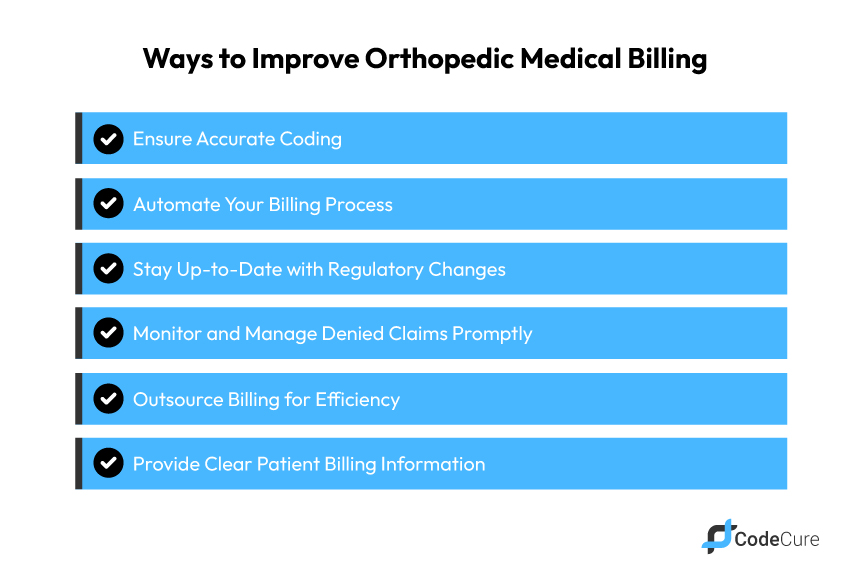
Improving billing accuracy, reducing claim denials, and optimizing the revenue cycle are essential for orthopedic practices. By implementing these tips, practices can streamline their billing process, ensuring timely reimbursements. This not only enhances cash flow but also allows healthcare providers to focus more on what truly matters: delivering excellent patient care.
How CodeCure Can Help Boost Your Orthopedic Practice’s Revenue
At CodeCure, we specialize in orthopedic medical billing and offer a comprehensive solution tailored to meet the needs of your practice. Here’s how we can help:
1. Expert Orthopedic Billing
We understand the complexities of orthopedic billing. Our team ensures that all claims are accurately coded using the correct ICD-10, CPT, and HCPCS codes, reducing the risk of denials and delays.
2. Faster Claims Processing
With our automated claim submission and real-time insurance verification tools, we help your practice process claims faster, reducing the chances of errors and speeding up reimbursement.
3. Comprehensive Revenue Cycle Management
CodeCure offers end-to-end management of your revenue cycle, handling everything from claim submission to payment follow-up, allowing you to focus on patient care while we optimize your cash flow.
4. Detailed Reporting
Our system provides actionable insights through detailed reports, helping you track denial rates, accounts receivable, and other key metrics. This allows for continuous improvement in your billing process.
5. Regulatory Compliance
With CodeCure, you never have to worry about staying up-to-date with industry regulations. We ensure that your practice is compliant with HIPAA, CMS guidelines, and the latest coding standards, minimizing the risk of penalties.
6. Customized Solutions
We recognize that each orthopedic practice has unique needs. That’s why we offer tailored billing solutions that fit your specific requirements, whether you choose to handle billing in-house or outsource it to us.
By partnering with CodeCure, your practice can experience improved cash flow, reduced denials, and a more efficient billing process, ultimately boosting your revenue and giving you more time to focus on patient care.
Conclusion
Orthopedic medical billing is complex, but with the right solutions in place, orthopedic practices can improve their revenue cycle, minimize errors, and streamline operations. Whether you choose to implement an in-house solution or outsource to experts, optimizing your billing process is key to maintaining financial stability and growing your practice.
Contact CodeCure today to learn how we can help optimize your orthopedic medical billing and boost your practice’s revenue.