



In 2026, medical claim denials continue to challenge healthcare providers as payer rules become increasingly stringent and billing standards evolve. The financial impact of these denials is significant, resulting in delayed reimbursements, lost revenue, and added administrative costs. According to the American Hospital Association (AHA), U.S. hospitals faced an estimated $19.7 billion loss in appeals for denied claims in 2022 alone. With the average claim exceeding $14,000, denials are far from minor disruptions. Therefore, understanding denial codes, the standardized identifiers that explain the reasons for claim rejections or reductions, is essential to navigating these complexities.
What Are Denial Codes?
Denial codes are specific, standardized codes issued by insurance payers to explain why a claim has been rejected or reduced in payment. These codes clarify whether the issue stems from incorrect diagnosis coding, incomplete documentation, eligibility issues, or other billing errors. By knowing these codes, healthcare providers can quickly address the root cause of the issue and take appropriate corrective actions.
These codes are used by a variety of payers, including government insurers like Medicare and Medicaid, as well as commercial insurers like Aetna, UnitedHealthcare, and Blue Cross Blue Shield.
Why Denial Codes Matter
Denial codes play a crucial role in identifying specific issues within the claim submission process, offering transparency into the areas where errors occur. These codes help providers avoid financial losses by enabling faster resolutions, whether through appeals, resubmissions, or corrections to documentation. In a rapidly evolving healthcare landscape, tracking these codes is a critical practice for healthcare providers aiming to maximize reimbursements and maintain a healthy revenue cycle.
Proper understanding and management of denial codes are especially crucial in Revenue Cycle Management (RCM). When healthcare providers fail to resolve claims promptly, it can significantly impact their cash flow and delay reimbursements, ultimately affecting the financial health of the practice.
Common Denial Codes in 2026
Below is a table highlighting the most common denial codes you’ll encounter in 2026. It provides descriptions of each code, the typical reasons for denial, and practical tips on how to prevent them, helping you manage and resolve claim denials more efficiently
| Denial Code | Description | Common Causes | Prevention Tips |
| CO-11 | Diagnosis Inconsistent with Procedure | ICD-10 diagnosis does not support CPT/HCPCS code under payer medical necessity policies; automated edits flag mismatches before adjudication. | Ensure diagnosis codes clearly justify services rendered. Use medical necessity checking tools before submission and conduct regular coding audits aligned with payer LCD/NCD policies. |
| CO-16 | Claim Lacks Information or Has Errors | Missing demographics, invalid NPI, incorrect modifiers, absent authorization numbers, or incomplete documentation. | Strengthen front-end registration workflows, implement automated claim scrubbing, and verify provider credentials and patient data prior to submission. |
| CO-50 | Non-Covered Services | Service not covered under patient’s plan, benefit limitations exceeded, or missing prior authorization. | Perform real-time eligibility and benefits verification. Confirm coverage limitations and obtain required prior authorizations before service delivery. |
| CO-45 | Charge Exceeds Fee Schedule | Billed charge exceeds contracted allowable amount; fee schedule discrepancies. | Maintain updated payer fee schedules in billing systems. Conduct contract reviews and payment variance analysis to ensure reimbursement accuracy. |
| CO-97 | Service Included in Another Procedure (Bundled) | National Correct Coding Initiative (NCCI) edits bundle services; improper modifier use. | Review NCCI edits regularly. Apply appropriate modifiers (e.g., 59, XS, XP) when documentation supports separate and distinct services. |
| CO-29 | Timely Filing Limit Exceeded | Claim submitted after payer-specific filing deadline due to documentation delays or workflow inefficiencies. | Track payer filing deadlines in RCM systems. Establish internal submission benchmarks and automate reminders to avoid delays. |
| CO-18 | Duplicate Claim | Same claim submitted more than once; resubmission before adjudication completed. | Check clearinghouse and payer portals before resubmitting. Use duplicate detection alerts within billing software. |
Emerging Denial Trends in 2026
The denial landscape in 2026 is being reshaped by rapid shifts in care delivery models and reimbursement structures. As telemedicine and remote emergency consultations expand, new denial patterns are emerging. Telehealth-related claims are frequently rejected due to incorrect Place of Service (POS) coding, missing or inaccurate modifiers such as 95 or GT, or failure to meet evolving payer-specific documentation requirements. Because telehealth policies continue to change at both the federal and commercial payer levels, even minor compliance gaps can result in avoidable rejections or payment delays.
At the same time, the growing adoption of value-based and outcome-driven reimbursement models is introducing another layer of risk. Claims tied to quality benchmarks or performance reporting may face denial if required clinical data, outcome metrics, or reporting elements are incomplete. As reimbursement becomes increasingly linked to documentation accuracy and measurable outcomes, healthcare providers must proactively monitor payer updates, refine telehealth workflows, and strengthen quality reporting processes to prevent revenue disruption.
Soft vs. Hard Denials
Medical billing denials fall into two categories: hard denials and soft denials. Understanding the difference is crucial for effective denial management.
Soft Denials: These are temporary denials that can be corrected and resubmitted. They are usually caused by minor issues, such as missing patient information or coding errors. Soft denials can often be resolved with additional documentation or corrected codes.
Hard Denials: These denials are permanent and cannot be resubmitted. They typically occur when services are not covered by the patient’s insurance, the claim is submitted too late, or the provider is not credentialed with the payer. Once issued, hard denials result in lost revenue.
Strategies to Prevent Claim Denials Before They Occur
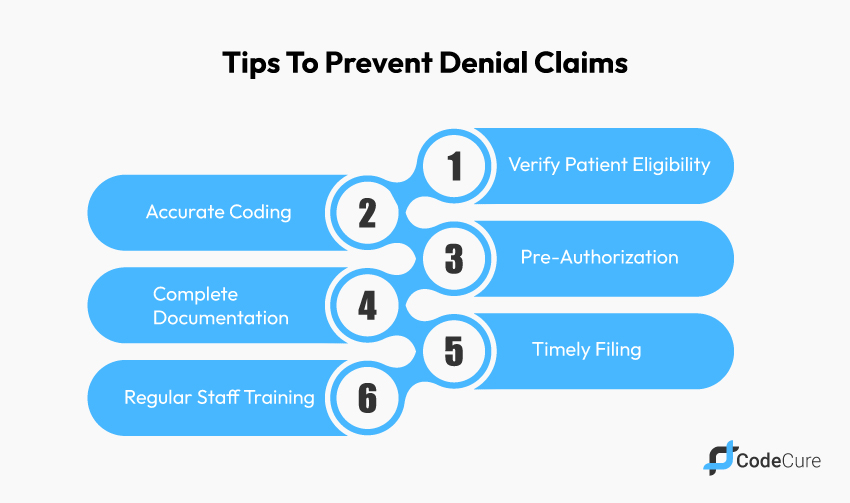
Prevention is the most effective way to reduce claim denials. Here are key strategies to avoid denials from the start:
- Verify Patient Eligibility:
Always check the patient’s insurance status and benefits before providing services. This ensures that claims are submitted with correct insurance details and coverage.
- Accurate Coding:
Use accurate and up-to-date ICD-10, CPT, and HCPCS codes. Ensure that the diagnosis supports the procedure and that modifiers are applied correctly.
- Pre-Authorization:
Obtain prior authorization for services that require it. Ensure that the authorization is documented and included on the claim.
- Complete Documentation:
Proper documentation of the patient’s visit, including medical necessity, treatment, and any related services, is essential to support the claim.
- Timely Filing:
Submit claims within the payer’s deadlines. Use automated reminders to track submission dates and avoid late claims.
- Regular Staff Training:
Regularly train your billing staff on the latest coding updates, payer policies, and best practices for claim submission.
The Role of AI and Automation in Denial Management in 2026
As healthcare billing continues to evolve in 2026, AI and automation are playing an increasingly crucial role in reducing medical claim denials and improving revenue cycle efficiency. With rising payer scrutiny, complex documentation standards, and changing reimbursement models, manual billing processes are no longer sufficient. AI-driven solutions and automated workflows are essential for staying ahead of denials and optimizing claim accuracy.
Here’s how AI and automation are revolutionizing denial management:
- Automated Claim Scrubbing:
AI-powered claim scrubbing tools automatically check claims for errors before submission, catching issues like missing data or incorrect codes. This reduces rejections and ensures clean claims are sent to payers, improving first-pass acceptance rates.
- Denial Prediction:
AI analyzes historical claims data and payer-specific trends to predict which claims are most likely to be denied. This allows providers to address issues proactively before claims are submitted, minimizing denials and accelerating cash flow.
- Automated Denial Tracking & Follow-Up:
AI systems track denied claims and automatically flag them for follow-up. They can even generate resubmission paperwork, reducing administrative burden and ensuring timely claim resolution.
- Real-Time Eligibility Verification:
Automated tools verify patient insurance details in real time, ensuring accurate information is provided before the service is rendered, significantly reducing eligibility-related denials.
- AI-Driven Coding Compliance:
AI tools ensure accurate coding by checking CPT, ICD-10, and HCPCS codes against payer guidelines. They help coders avoid common errors, ensuring claims are correctly submitted the first time.
In 2026, AI and automation are no longer optional; they are essential for reducing medical claim denials and ensuring timely reimbursements. By leveraging these technologies, providers can streamline their billing processes, minimize rejections, and ensure steady revenue flow, ultimately improving financial sustainability.
With CodeCure, you can optimize your revenue cycle with AI-powered claim scrubbing, denial prediction, and automated follow-up, ensuring your practice stays on top of evolving payer requirements and maximizes reimbursements.
Why Outsource Your Revenue Cycle Management to CodeCure?

Outsourcing your Revenue Cycle Management (RCM) to CodeCure allows your practice to focus on what you do best, delivering excellent patient care while we handle the complexities of medical billing and coding. Our end-to-end services ensure seamless management of the entire revenue cycle, from patient registration to payment posting, all while improving claim accuracy and reducing administrative burdens.
Outsourcing to CodeCure helps you achieve faster reimbursements, reduce claim denials, and streamline your processes, which ultimately improves cash flow. Our team of experienced specialists is dedicated to minimizing errors, ensuring compliance, and optimizing your revenue cycle with real-time eligibility verification, E/M coding audits, and automated claim management.
By partnering with us, you eliminate the need to invest in expensive in-house billing staff and infrastructure, while benefiting from our expertise and cutting-edge technology. Outsourcing your RCM process to CodeCure allows you to reduce overhead costs, enhance operational efficiency, and ensure timely reimbursements, all without compromising the quality of care you provide your patients. Let us handle your billing so you can concentrate on growing your practice.
Conclusion:
In 2026, reducing medical claim denials is essential for maintaining financial stability. By understanding denial codes and leveraging AI and automation, healthcare providers can improve cash flow and optimize their revenue cycle. At CodeCure, we provide the expertise and tools to help your practice minimize denials and ensure timely reimbursements.
Contact CodeCure today to streamline your revenue cycle and reduce denials!
FAQs
1. What are the most common medical billing denial codes in 2026?
The top denial codes include CO-11 (diagnosis inconsistent with procedure), CO-16 (missing claim info), CO-50 (non-covered services), CO-45 (charge exceeds fee schedule), CO-97 (bundled services), CO-29 (timely filing exceeded), and CO-18 (duplicate claim). These typically stem from coding errors, documentation gaps, missing authorizations, or registration mistakes.
2. Why are claim denials rising in 2026?
Denials are increasing due to stricter payer audits, Medicare Advantage scrutiny, AI-driven claim edits, and value-based reimbursement models. Minor documentation or coding errors can now trigger immediate rejections.
3. How much do claim denials cost practices?
Denied claims can cost thousands per claim and billions annually in lost revenue. Beyond direct losses, practices face administrative costs for rework, appeals, and delayed payments.
4. What is the difference between soft and hard denials?
Soft denials are temporary and can be corrected, usually due to missing info or coding errors. Hard denials are permanent, often from non-covered services or late submission, resulting in lost revenue.
5. How can practices reduce denial rates?
Reducing denials requires real-time eligibility checks, accurate coding, prior authorizations, pre-submission audits, and leveraging AI for claim scrubbing and denial prediction.
6. How does Medicare Advantage impact denials?
Medicare Advantage applies stricter medical necessity reviews, frequent audits, and more complex documentation rules, increasing the likelihood of claim rejection.
7. How does AI prevent denials?
AI identifies high-risk claims, scrubs for coding and data errors, tracks eligibility, and predicts likely denials, helping practices submit clean claims and improve cash flow.
8. Why track denial codes?
Monitoring denial codes highlights recurring errors, whether in coding, documentation, or intake. This enables targeted corrections to reduce revenue loss and optimize the revenue cycle.
9. Should practices outsource denial management?
Outsourcing gives access to expert billing staff, payer-specific knowledge, and automation tools, reducing denials, speeding reimbursements, and lowering overhead costs.