

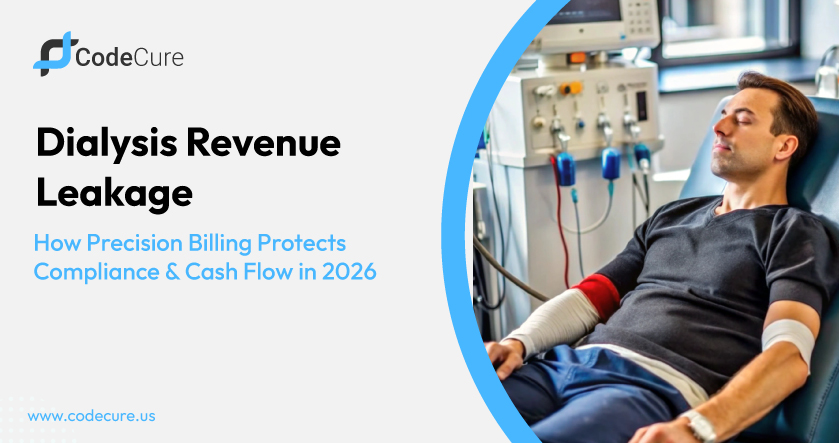
Dialysis practices don’t struggle because of low patient volume; they struggle because revenue silently disappears inside billing complexity. On paper, care delivery is consistent and high-frequency, but in reality, payments keep getting delayed, reduced, or lost due to compliance-heavy billing rules that most workflows fail to fully control.
What’s really causing the leak? Small coding or modifier errors repeat across every treatment cycle, missing clinical documentation triggers payer holds, and authorization gaps stop claims before they ever reach payment.
In dialysis billing, these aren’t one-time issues; they multiply across recurring treatments, turning minor gaps into major revenue loss. In 2026, the real challenge is no longer just submitting claims, but ensuring every single claim survives payer scrutiny in a system built for continuous validation. This is where precision billing becomes the difference between stable cash flow and ongoing revenue leakage.
What Dialysis Revenue Leakage Really Means
Dialysis revenue leakage refers to the gradual loss of earned revenue due to breakdowns in billing, coding, documentation, and payer-compliance workflows.
Unlike denials, leakage is often invisible; claims may still be processed, but at reduced value, with delayed timelines, or with incomplete reimbursement.
Because dialysis operates under the CMS ESRD bundled payment system, even small inconsistencies can repeat across multiple weekly treatments for the same patient, multiplying financial loss.
Where leakage originates:
- Pre-billing gaps → eligibility issues, authorization delays
- Submission errors → modifier mistakes, unit mismatches, coding inaccuracies
- Post-submission breakdowns → missed follow-ups, underpayment oversight, aged AR
Healthcare organizations lose an estimated 5–10% of annual net revenue due to preventable revenue cycle inefficiencies, and dialysis is especially exposed because of its repetitive billing structure.
In dialysis, leakage is not a single event; it is a recurring cycle across every treatment episode.
How Dialysis Revenue Leakage Actually Happens
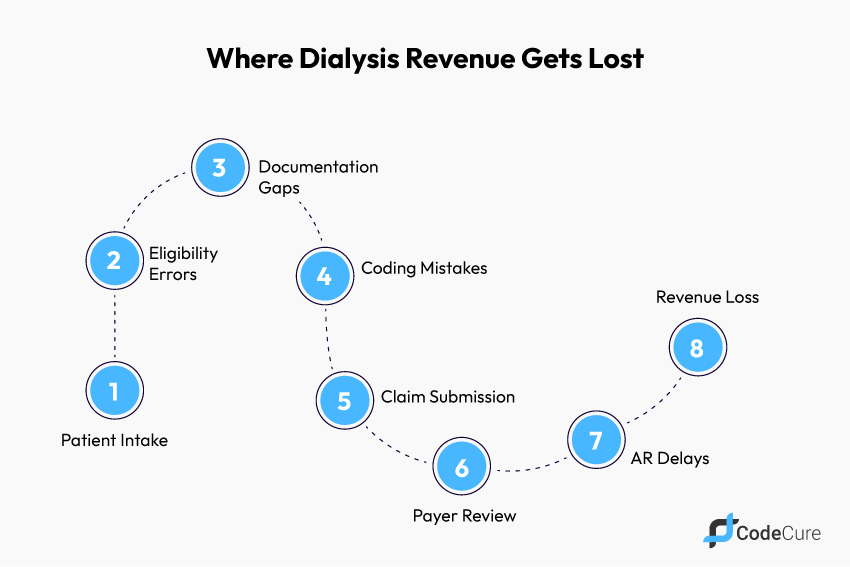
Revenue leakage builds gradually across the entire billing lifecycle rather than from one failure point.
- Intake & Eligibility Breakdowns
Incomplete eligibility verification or delayed authorization checks create downstream claim disruptions that repeat across multiple sessions.
- Documentation Misalignment
Dialysis claims require precise clinical-to-billing linkage. Missing treatment justification or inconsistent physician documentation weakens claim validity.
- Coding & Modifier Errors
Incorrect modifiers, unit reporting issues, or frequency mismatches can affect multiple claims for the same patient under ESRD bundled rules.
- Payer Review Layer Delays
Automated edits, utilization reviews, and bundled payment validations often delay even clean claims.
- Post-Payment Gaps
Underpayments, missed adjustments, and delayed AR follow-ups create silent revenue loss that often goes undetected.
Leakage in dialysis is not isolated; it is cumulative and system-wide.
What Precision Billing Really Means in Dialysis
Precision billing is not about coding accuracy alone; it is a structured revenue protection system that ensures claims are compliant before submission.
In dialysis, where billing is repetitive and tightly regulated, precision becomes the difference between stable cash flow and continuous leakage.
It includes:
- Compliance validation before claim submission
- Documentation alignment with ESRD treatment cycles
- Modifier and unit accuracy checks
- Frequency validation under bundled payment rules
- Payer-specific rule mapping (Medicare + commercial plans)
Precision billing is not about submitting claims; it’s about ensuring claims are compliant before they reach the payer.
How Claims Get “Stuck” in Dialysis AR Systems
Even after submission, claims often stop moving within the AR cycle, delaying reimbursement and increasing financial risk.
- Payer Holds (Compliance Layer)
Claims are paused for medical necessity review, bundled payment validation, or audit triggers, even when documentation is complete.
- Missing Trigger Events
Missing operative notes, incomplete clinical linkage, or authorization mismatches prevent claim progression.
- Workflow Breakdowns
Delayed follow-ups, unworked AR buckets, and weak escalation processes keep claims stuck beyond recovery windows.
Once claims cross 60+ days in AR, recovery probability drops significantly and cash flow becomes unstable.
AR Aging & DSO Impact in Dialysis Revenue Cycle
AR aging is one of the strongest indicators of revenue health in dialysis due to high-frequency treatment cycles.
Dialysis AR Aging Breakdown
| AR Stage | Status | Revenue Risk | Action Required |
| 0–30 Days | Normal processing | Low | Monitor claims |
| 30–60 Days | Early delay | Moderate | Follow-ups required |
| 60–90 Days | High-risk zone | High | Escalation needed |
| 90+ Days | Revenue leakage | Critical | Recovery focus |
The most critical shift occurs after 60 days, when delayed claims begin converting into permanent revenue loss.
DSO Impact in Dialysis
As AR aging increases beyond 60 days, Days Sales Outstanding (DSO) rises significantly, reducing cash flow predictability.
Higher DSO leads to:
- Slower reimbursement cycles
- Reduced operational liquidity
- Limited growth planning capacity
Because dialysis billing is continuous, even small delays compound across multiple treatment cycles.
Top Compliance Risks Driving Dialysis Payment Delays in 2026
Dialysis payment delays in 2026 are increasingly driven by compliance enforcement, bundled payment validation, and payer-specific rule variation, not just billing errors.
Below are the most critical compliance risks affecting dialysis reimbursements today:
1. ESRD Bundled Payment Compliance Errors
Dialysis services fall under the Medicare ESRD Prospective Payment System (PPS), which bundles multiple services into a single payment structure. Even minor mismatches in reporting included services, add-on treatments, or frequency adjustments can trigger payment holds or reprocessing delays.
CMS continues to tighten bundled payment audits, increasing documentation verification before claims are released.
2. Authorization & Referral Compliance Gaps
Many dialysis-related services now require strict authorization alignment, especially when patients transition between care settings or insurance plans. Missing, expired, or misaligned referrals often lead to claim suspension or extended review cycles.
Payer systems increasingly auto-flag authorization inconsistencies before adjudication.
3. Medical Necessity Documentation Scrutiny
Dialysis claims are frequently reviewed for clinical justification, particularly in cases involving changes in treatment frequency or modality. Incomplete or non-specific documentation can result in additional payer requests or delayed approvals.
Payers are increasingly using AI-driven pre-payment review systems to validate necessity.
4. Modifier & Coding Compliance Variability
Dialysis billing requires precise application of modifiers, revenue codes, and unit reporting structures. Even small inconsistencies can trigger automated payer edits, especially in recurring claims for the same patient.
Coding inconsistencies often lead to systemic delays across multiple claim cycles.
5. Payer-Specific Policy Variations
Commercial payers often apply rules that differ significantly from Medicare ESRD guidelines. This creates variability in documentation expectations, submission formats, and reimbursement timelines across different plans.
Lack of payer-specific workflows increases the risk of delayed or inconsistent payments.
The Hidden Multiplier Effect in Dialysis Billing Errors
In dialysis billing, revenue loss rarely comes from a single mistake it compounds across repeated treatment cycles. Since patients receive services multiple times per week, even a small error can impact numerous claims linked to the same patient.
A single issue can multiply quickly:
- One modifier error can affect multiple claims
- One eligibility gap can disrupt an entire treatment cycle
- One documentation issue can trigger repeated payer reviews
- One authorization problem can stall several service dates
In high-frequency care like dialysis, small billing inconsistencies can quietly compound into ongoing revenue leakage rather than one-time losses.
In 2026, this risk is amplified as payers increasingly analyze claim patterns across episodes of care, meaning repeated services are more likely to be flagged, delayed, or reprocessed together.
The key issue is not isolated errors; it’s how those errors repeat across the entire revenue cycle.
The Real Financial Impact of Dialysis Billing Errors
Dialysis billing errors don’t just create delays; they directly disrupt predictable monthly revenue cycles because treatments are repetitive and high-frequency under ESRD bundled payments.
Even small errors compound quickly:
- A single mistake affects multiple weekly treatments per patient
- Underpayments reduce bundled reimbursement accuracy
- Delays push claims into 60+ day AR risk zones
In most dialysis practices, the real issue is not claim submission; it is loss of full reimbursement over time due to repeated cycle errors.
As a result, even “processed” claims often fail to reflect true revenue collection, creating silent leakage across the entire patient population.
Precision Billing Framework for Dialysis Practices (2026)
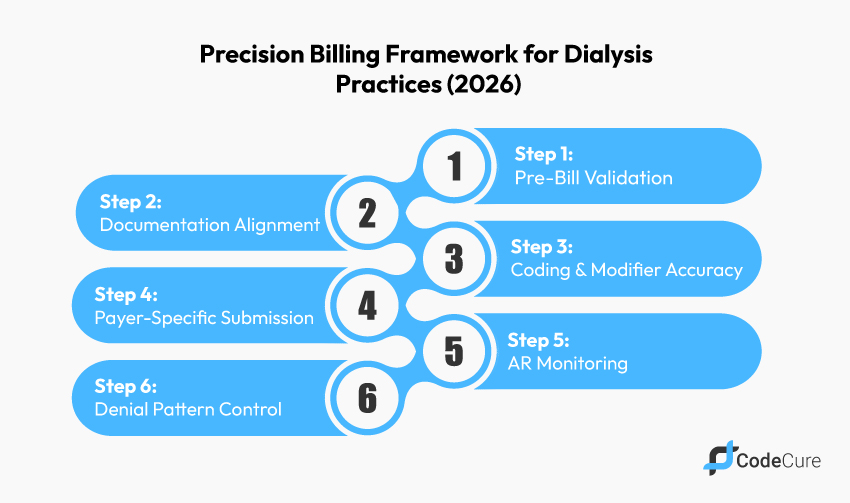
Precision billing in dialysis is not just about submitting clean claims; it is a structured control system that prevents revenue leakage across every treatment cycle. Because dialysis services are repetitive and governed by strict ESRD bundled payment rules, even small errors can multiply into continuous financial loss if not controlled at each stage.
Step 1: Pre-Bill Validation (Prevent Revenue Leakage Early)
Precision billing starts before submission with eligibility, authorization, and ESRD rule validation. Eligibility, active authorization, and referral status must be verified for every treatment cycle to avoid downstream denials. ESRD bundle rules and payer-specific requirements should also be confirmed upfront, since most dialysis revenue issues originate at intake rather than submission.
Step 2: Documentation Alignment (Clinical-to-Billing Accuracy)
Every dialysis claim must reflect accurate clinical justification. Treatment frequency, physician orders, and medical necessity must be clearly documented and aligned with ESRD requirements. When documentation lacks clarity or consistency, claims are more likely to trigger payer reviews or delayed approvals.
Step 3: Coding & Modifier Precision (Cycle-Level Accuracy)
Dialysis billing depends on highly repetitive claims, making coding accuracy critical. ESRD-related modifiers, unit reporting, and treatment session details must remain consistent across cycles. Even minor coding inconsistencies can repeat across multiple claims for the same patient, increasing cumulative revenue loss.
Step 4: Payer-Specific Submission (Rule Matching)
Each payer processes dialysis claims differently, especially under Medicare ESRD versus commercial plans. Precision billing ensures claims are formatted according to payer-specific rules, including documentation structure and bundled payment interpretation. Mismatched submissions often result in avoidable delays rather than true denials.
Step 5: AR Monitoring (Stop Aging Revenue Loss)
Once claims enter AR, continuous tracking becomes essential. Dialysis claims must be actively monitored across aging buckets, especially after 60 days, where recovery probability begins to decline. Early identification of underpayments and stalled claims prevents revenue from shifting into write-off risk zones.
Step 6: Denial Pattern Control (System-Level Fixes)
Dialysis denials are rarely isolated events; they follow predictable payer patterns. Precision billing focuses on identifying recurring denial reasons and fixing root causes at the workflow level instead of reworking individual claims. This prevents repeated revenue disruption across treatment cycles.
How Technology Improves Dialysis Billing Accuracy (2026)
Dialysis billing is too repetitive and compliance-heavy for manual workflows alone. In 2026, automation is essential to prevent revenue leakage at scale.
AI tools now catch coding errors, modifier mismatches, and documentation gaps before submission, stopping repeat errors across recurring claims. Real-time eligibility and authorization checks prevent claims from getting stuck in AR due to missing approvals.
Rule-based engines automatically apply ESRD bundled payment logic and payer-specific requirements, reducing rejections caused by compliance inconsistencies. At the same time, AR analytics flag claims nearing 60+ days, enabling early intervention before revenue turns into loss.
In short, automation shifts dialysis billing from reactive correction to proactive revenue protection.
Why Dialysis Practices Are Outsourcing Billing in 2026
In dialysis, outsourcing is no longer operational support; it is revenue risk management in a high-compliance environment. Dialysis billing is becoming harder to manage in-house as compliance requirements tighten and workloads increase across recurring treatment cycles. Many practices are shifting to outsourced models not just for efficiency, but for stronger revenue control.
Key drivers include:
- Rising compliance pressure under ESRD billing rules
- Staff overload from high-frequency, repetitive claims
- Recurring denial cycles impacting cash flow
- Increasing AR follow-up and recovery burden
Outsourcing is no longer just about reducing costs—it’s a strategic move to protect revenue, ensure compliance, and maintain predictable cash flow in a complex billing environment.
How CodeCure Protects Dialysis Revenue
Dialysis revenue doesn’t disappear by accident; it leaks through small gaps repeated across every treatment cycle. CodeCure closes those gaps before they turn into losses.
We bring a precision-first approach that stops errors at the source, not after they hit AR. Every claim is validated for ESRD compliance, coding accuracy, and payer-specific rules before submission, so denials don’t get the chance to repeat across multiple sessions. From there, our system-driven workflows keep claims moving, no stagnation, no silent aging.
We actively control AR with real-time tracking, fast corrections, and payer-specific follow-ups, ensuring revenue doesn’t drift into 60+ day risk zones. At the same time, audit-ready documentation and compliance alignment protect your practice from recoupments and payment delays.
We don’t chase payments; we prevent revenue loss, accelerate cash flow, and build a billing system that keeps your dialysis revenue predictable, protected, and growing.
Conclusion
Dialysis billing is continuous, and so are its risks. When small errors repeat across high-frequency treatments, revenue doesn’t just get delayed it steadily erodes. In 2026, reactive billing is no longer enough. The real advantage comes from precision billing, where compliance, documentation, and payer rules are aligned before claims are submitted, ensuring faster, cleaner, and more predictable payments.
If your dialysis revenue is stuck in AR or slipping through underpayments, it’s time to fix the system behind it. CodeCure helps you stabilize cash flow, reduce delays, and protect every dollar you earn. Get in touch today and take control of your dialysis revenue with a precision-driven approach.
FAQ
What is dialysis revenue leakage?
Dialysis revenue leakage is the gradual loss of earned revenue due to errors in billing, coding, documentation, and payer compliance that lead to delayed or incomplete reimbursement.
Why do dialysis claims get delayed or stuck in AR?
Dialysis claims get stuck in AR due to payer holds, missing documentation, authorization issues, coding errors, and delayed follow-ups that prevent timely reimbursement.
How does ESRD bundled payment affect dialysis billing?
The ESRD bundled payment system groups dialysis services into a single payment, meaning even small billing errors can impact multiple services and reduce overall reimbursement.
What causes most revenue loss in dialysis billing?
Most revenue loss occurs due to recurring coding mistakes, documentation gaps, authorization failures, and missed underpayments across repeated treatment cycles.
What is precision billing in dialysis?
Precision billing is a structured billing approach that ensures compliance, documentation accuracy, and payer-rule alignment before claims are submitted to prevent revenue leakage.
How does AR aging impact dialysis revenue?
As AR ages beyond 60 days, the likelihood of full payment decreases, cash flow slows, and claims move into higher risk zones for write-offs and revenue loss.
How can dialysis practices reduce revenue leakage?
Dialysis practices can reduce revenue leakage by implementing pre-bill validation, accurate coding, strict documentation alignment, payer-specific workflows, and continuous AR monitoring.