In 2026, behavioral health practices are losing more revenue than ever, not because services aren’t covered, but because claims are getting rejected before payment is even considered. Small errors in documentation, authorization, or coding are now enough to stop reimbursements completely. With denial rates reaching 10%–20%, every rejected claim directly slows cash flow and increases operational pressure for therapists, psychiatrists, ABA providers, and telehealth clinics.
This guide uncovers the most common behavioral health claim denials, why they happen, and how to fix them before they impact your revenue.
Why Behavioral Health Claim Denials Are Rising in 2026
Behavioral health claim denials are accelerating in 2026 as payers shift from manual reviews to automated, AI-driven claim validation systems. Instead of reviewing claims after submission, insurers now flag and reject behavioral health billing services in real time for even the smallest inconsistencies, often before a human ever sees the file. A minor mismatch in documentation, coding, or authorization can now mean instant denial and delayed revenue.
At the same time, behavioral health denial management is becoming more restrictive due to stricter utilization reviews, expanded prior authorization rules, and heavier enforcement of medical necessity across all major payers.
What’s driving the surge in denials:
- 35%+ increase in prior authorization requirements across major insurance plans
- 25% rise in telehealth claim audits in 2026 alone
- Rapid adoption of AI-powered claim scrubbing and automated rejection systems
- Higher denial rates across psychotherapy, ABA therapy, and intensive outpatient services
The result? Behavioral health practices are now experiencing sudden denial spikes after payer policy updates, especially when behavioral health carve-out changes happen without clear provider-level communication.
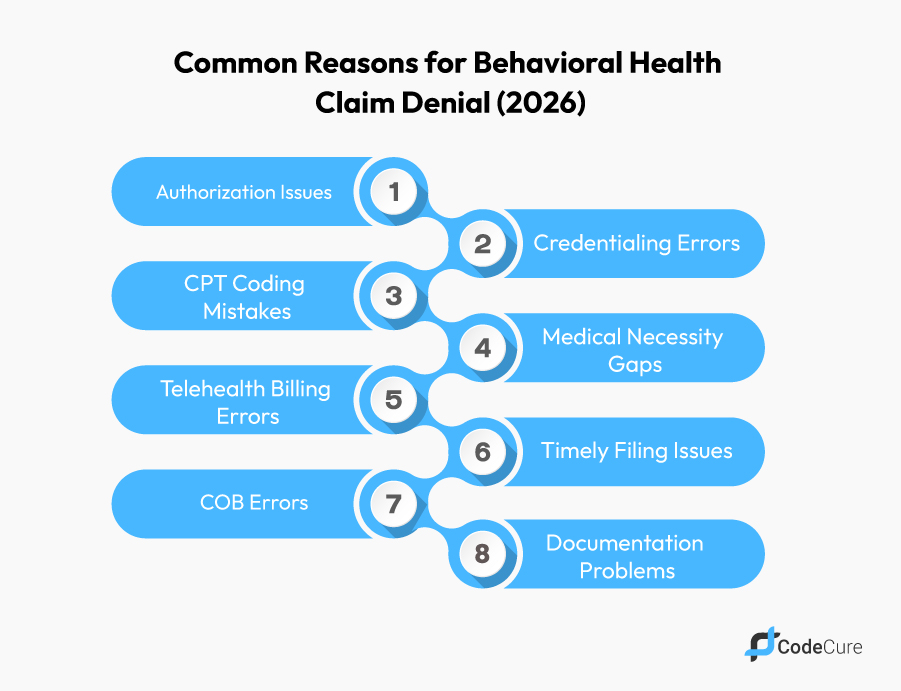
Most Common Behavioral Health Claim Denials in 2026
Behavioral health claim denials in 2026 are no longer random they follow clear operational patterns tied to authorization failures, credentialing gaps, documentation issues, and coding mismatches. Understanding these denial triggers is the first step to improving clean claim rates and protecting revenue flow.
1. Authorization Denials
Authorization-related denials remain one of the most frequent and costly issues in behavioral health billing. These occur when services are delivered without proper approval or when claim details don’t align with the authorized treatment plan.
Common triggers include:
- Missing prior authorization
- Expired or lapsed approvals
- Incorrect CPT-to-authorization mapping
- Exceeding approved session limits
High-risk services include intensive outpatient programs (IOP), ABA therapy, psychological testing, and substance use treatment.
To reduce these denials, behavioral health billing services must shift toward real-time eligibility checks and proactive authorization tracking before every visit.
2. Credentialing and Enrollment Denials
Credentialing errors are becoming a silent revenue leak in 2026. If provider data doesn’t exactly match payer records, claims are automatically rejected often without manual review.
Common issues include:
- Inactive or expired CAQH profiles
- Incorrect taxonomy codes
- Rendering vs billing provider mismatches
- Outdated payer enrollment records
Operational benchmarks show that nearly 18% of behavioral health denials are linked directly to credentialing and enrollment inconsistencies, making this one of the most preventable denial categories in revenue cycle management.
3. Medical Necessity Denials
Medical necessity is now one of the most aggressively audited areas in behavioral health reimbursement. Payers are increasingly rejecting claims when documentation fails to justify treatment intensity or clinical need.
Common denial triggers include:
- Missing or unclear treatment goals
- Weak or vague clinical justification
- Lack of measurable patient progress
- Repetitive or unsupported session frequency
Behavioral health practices frequently see denial spikes when documentation does not fully support CPT-level intensity requirements or payer-defined care standards.
4. Incorrect CPT Coding Denials
Coding errors continue to be a major driver of psychotherapy billing denials and behavioral health reimbursement challenges. These often occur due to incorrect time-based coding, missing modifiers, or outdated CPT selection.
Even when services are clinically valid, claims are frequently denied if documentation does not align with CPT definitions and time requirements.
Most Denied Behavioral Health CPT Codes in 2026
| CPT Code |
Common Denial Reason |
| 90837 |
Documentation mismatch or time validation issues |
| 90834 |
Insufficient time documentation |
| 90791 |
Missing or expired authorization |
| 96130 |
Incomplete psychological testing documentation |
| H0031 |
Medicaid coverage restrictions |
Behavioral health practices often experience sharp denial spikes when CPT-level documentation fails to match payer expectations for time, complexity, and medical necessity.
5. Telehealth Claim Denials
Telehealth expansion has improved access to care but it has also increased behavioral health claim denials due to inconsistent payer rules across states and insurers.
Common denial reasons include:
- Incorrect place-of-service (POS) codes
- Missing telehealth modifiers
- Multi-state licensing conflicts
- Non-covered virtual service rules
Industry data shows that telehealth-related behavioral health denials increased by 22% in 2026, largely due to compliance enforcement and cross-state licensing validation.
Insurance-Specific Behavioral Health Claim Denials
Behavioral health claim denials vary significantly by payer due to differences in authorization rules, documentation standards, and behavioral health carve-outs. Understanding these payer-specific patterns is essential for reducing mental health claim denials and improving behavioral health reimbursement performance in 2026.
Denial patterns across behavioral health billing show consistent spikes after payer policy updates and behavioral health carve-out changes. Most providers experience revenue disruption when billing systems are not updated in alignment with payer requirements.
Aetna Behavioral Health Claim Denials
Aetna denials are commonly driven by authorization mismatches and network participation issues.
- Missing or incorrect prior authorization
- Out-of-network rendering provider
- Incorrect behavioral health modifiers
Optum Behavioral Health Billing Denials
Optum denials are primarily linked to strict medical necessity reviews and carve-out restrictions.
- Medical necessity not met
- Behavioral health carve-out limitations
- Incomplete clinical documentation
Medicaid Behavioral Health Denials
Medicaid claims are highly sensitive to eligibility accuracy and state-specific billing rules.
- Eligibility verification errors
- Missing or expired authorization
- State-level documentation gaps
Medicare Mental Health Billing Errors
Medicare denials often occur due to administrative and enrollment inconsistencies.
- Incorrect CPT coding
- Provider enrollment mismatch
- Incomplete or outdated documentation
Behavioral health providers frequently experience denial spikes after payer policy updates or changes in reimbursement rules, especially when behavioral health billing systems are not updated in real time.
6. Timely Filing Denials
Timely filing denials remain one of the most avoidable yet costly revenue leaks in behavioral health billing. These denials occur when claims are submitted after the payer’s deadline resulting in automatic rejection, even if the service, documentation, and coding are completely accurate.
While filing windows vary across Medicare, Medicaid, and commercial payers, delays usually happen due to:
- Claim backlogs in billing teams
- Pending authorization approvals
- Credentialing or enrollment delays
- Missed submission tracking
In behavioral health revenue cycle management, even small workflow gaps can silently push claims past deadlines and directly impact reimbursement cycles.
7. Coordination of Benefits (COB) Denials
COB denials occur when payer hierarchy or insurance responsibility is incorrect at the time of billing. These are often preventable but continue to be a major issue due to outdated or incomplete eligibility data.
Common causes include:
- Incorrect primary insurance selection
- Missing or unverified secondary coverage
- Outdated patient insurance records
- Eligibility verification gaps before visits
Strong front-end insurance verification processes are essential to reduce COB-related behavioral health claim denials and avoid repeated rework in the revenue cycle.
Common Behavioral Health Denial Codes
Denial codes provide structured insight into why claims are rejected and are essential for effective denial management in behavioral health billing workflows.
| Denial Code |
Meaning |
| CO-16 |
Missing or incomplete information |
| CO-197 |
Prior authorization missing |
| CO-50 |
Medical necessity not met |
| CO-29 |
Timely filing expired |
| CO-18 |
Duplicate claim submission |
These denial codes frequently appear across Medicare, Medicaid, and commercial behavioral health claims and serve as key indicators for identifying systemic billing issues.
Financial Impact of Behavioral Health Claim Denials
Behavioral health claim denials don’t just delay payments they directly weaken revenue cycle performance and long-term financial stability. Every denied claim adds extra rework, slows reimbursement timelines, and increases pressure on already stretched billing teams.
On average, behavioral health organizations lose 10%–20% of collectible revenue due to preventable denial issues across authorization, coding, credentialing, and documentation gaps.
The impact extends beyond lost revenue and creates ongoing operational strain:
- Increased accounts receivable (A/R) days
- Higher claim rework and resubmission costs
- Greater administrative and billing workload
- Slower and inconsistent cash flow cycles
- Reduced overall operational efficiency
Without a structured denial prevention strategy, behavioral health revenue leakage compounds over time turning small billing errors into long-term financial losses and unstable reimbursement patterns.
Behavioral Health Denial Prevention Strategy for 2026
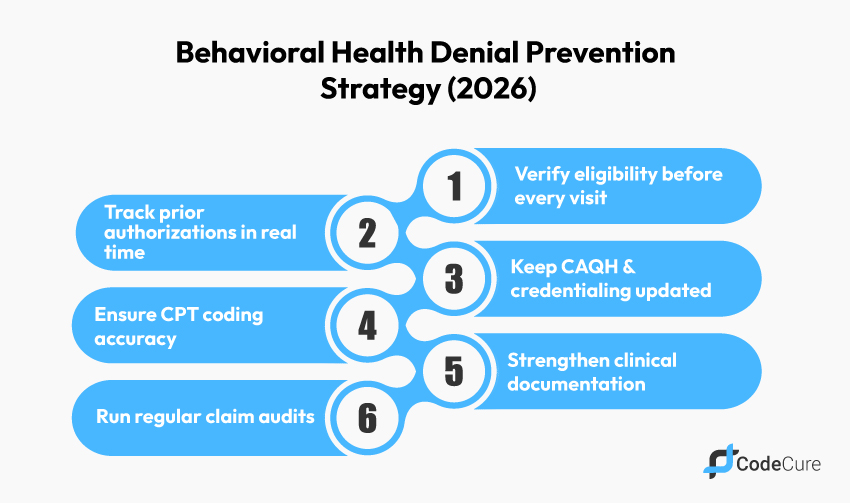
Reducing behavioral health claim denials in 2026 requires a structured, prevention-first approach within behavioral health denial management and end-to-end behavioral health revenue cycle management (RCM) integration. Most denials are not random errors; they are system breakdowns across eligibility, coding, credentialing, and documentation workflows.
Front-end verification is the foundation of effective behavioral health denial management. Eligibility checks, prior authorization validation, and payer-specific rule verification must be completed before every visit to prevent downstream claim rejections and protect revenue cycle stability.
Coding accuracy is a core driver of behavioral health reimbursement challenges. Continuous CPT audits, modifier validation, and structured coding training within behavioral health billing services significantly improve clean claim rates and reduce psychotherapy billing denials.
Credentialing accuracy is equally critical in behavioral health RCM integration. Outdated CAQH profiles, incorrect taxonomy codes, and inactive payer enrollment are leading causes of automatic claim rejections across Medicare, Medicaid, and commercial payers.
Finally, clinical documentation must fully support medical necessity, treatment progression, and CPT-level service justification to ensure claims remain compliant, defensible, and aligned with payer requirements.
How CodeCure Helps Reduce Behavioral Health Claim Denials
CodeCure.us helps behavioral health providers reduce claim denials, recover lost revenue, and strengthen behavioral health revenue cycle management (RCM) through structured workflows designed specifically for mental health billing environments. The focus is on preventing revenue leakage before it impacts cash flow, reimbursement speed, and operational stability.
Our approach targets the core causes of behavioral health claim denials, including authorization failures, coding mismatches, documentation gaps, and credentialing errors. Instead of reacting after denials occur, we focus on end-to-end behavioral health denial management that strengthens eligibility, billing accuracy, and payer compliance from the start.
We provide niche-specific support including behavioral health denial management services, psychotherapy billing denial audits, eligibility and prior authorization validation, credentialing verification and monitoring, telehealth billing compliance support, and revenue cycle optimization tailored for behavioral health billing services.
We work with therapists, psychiatrists, psychologists, PMHNPs, ABA providers, addiction treatment centers, and telehealth practices across the United States.
Our goal is simple and operational: reduce behavioral health claim denials, improve clean claim rates, and accelerate reimbursements through structured RCM systems built for behavioral health payer complexity.
Final Thoughts
Behavioral health claim denials in 2026 are rising due to stricter payer enforcement, increased automation, and evolving compliance requirements across insurance networks. Even minor gaps in authorization, coding accuracy, credentialing, or documentation can trigger claim rejections and disrupt revenue flow.
Practices that implement structured behavioral health denial management systems consistently see stronger clean claim rates, faster reimbursements, and more stable behavioral health revenue cycle management (RCM) performance. Every denied claim represents recoverable revenue but only when it is addressed through a proactive, system-driven denial prevention strategy rather than reactive correction.
CodeCure helps behavioral health providers reduce denial rates, improve billing accuracy, and strengthen revenue cycle performance before cash flow is impacted.
FAQs
What are the most common behavioral health claim denials?
The most common behavioral health claim denials include prior authorization denials, credentialing issues, medical necessity denials, CPT coding errors, telehealth billing mistakes, timely filing issues, and coordination of benefits (COB) errors.
Why are behavioral health claims denied so often?
Behavioral health claims are frequently denied due to missing prior authorizations, documentation gaps, incorrect CPT coding, outdated credentialing information, and stricter payer rules across Medicare, Medicaid, and commercial insurance.
What is behavioral health denial management?
Behavioral health denial management is the process of reducing and preventing claim denials by improving eligibility verification, authorization tracking, coding accuracy, documentation quality, and overall revenue cycle management (RCM) workflows.
How do you reduce behavioral health claim denials?
To reduce behavioral health claim denials, providers should verify insurance eligibility before visits, secure prior authorizations, maintain updated credentialing (CAQH), ensure accurate CPT coding, and strengthen documentation for medical necessity.
Which CPT codes are most often denied in behavioral health billing?
The most frequently denied CPT codes in behavioral health billing include 90837, 90834, 90791, 96130, and H0031, usually due to time validation errors, missing authorization, or insufficient documentation.
What causes credentialing-related claim denials in behavioral health?
Credentialing-related denials happen when provider details such as CAQH profiles, taxonomy codes, or payer enrollment records are outdated, inactive, or mismatched with billing information.
What is the denial rate for behavioral health claims?
Behavioral health claim denial rates typically range from 10% to 20%, depending on payer mix, documentation quality, authorization compliance, and the strength of the revenue cycle management (RCM) process.