



What if your ER physician group is leaving thousands, even millions, on the table in 2026 simply because of poor contract negotiations? The healthcare landscape has never been more complex. With Medicare reducing reimbursement rates, Medicaid failing to keep up with rising care costs, and private insurers tightening their contract terms, negotiating effectively with payers is more crucial than ever.
ER groups today face intense pressure to secure favorable contracts with major payers like Medicare, Medicaid, UnitedHealthcare, Aetna, and Blue Cross Blue Shield. If you’re not getting the best possible terms, you’re likely leaving money on the table, funds that could make a significant difference in covering overhead, staff compensation, and improving patient care.
Why ER Physician Groups Need Strong Contract Negotiations
When it comes to ER services, contract negotiations aren’t just a formality; they directly influence your practice’s financial health. The terms of these contracts set the reimbursement rates for emergency services, which impact:
- Revenue cycle efficiency and cash flow
- Operational costs, such as staffing, equipment, and technology investments
- Physician compensation and the ability to attract and retain top talent
- Patient access to care, particularly for those with Medicare or Medicaid
In states like California, where the ER physician workforce faces substantial pressure from rising patient volumes, strong contract terms are critical. ER physicians are often forced to work long hours, and Medicare and Medicaid reimbursements typically don’t cover the full cost of care. Without solid contracts with private insurers, such as Aetna or Blue Cross Blue Shield, ER practices may struggle financially and risk burnout.
Securing favorable reimbursement rates and contract terms is a key element of a sustainable practice. Without it, ER groups face:
- Fee schedule cuts from Medicare and Medicaid
- Increased denial rates due to complex billing requirements
- Cash flow disruptions from slow-paying payers
- Operational strain from staff shortages or overwork
Key Challenges ER Physician Groups Face in Contract Negotiations
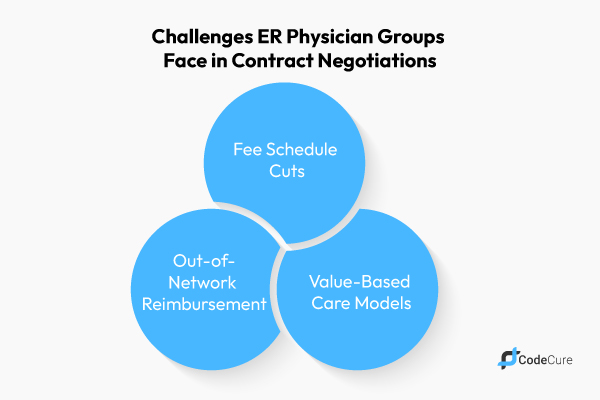
1. Fee Schedule Cuts
Both Medicare and Medicaid regularly adjust their fee schedules based on various factors like inflation and budget constraints. While these adjustments are necessary, they can lead to lower reimbursement rates for ER services. This presents a challenge, especially for ER groups in states like Florida or Texas, where large populations of Medicare and Medicaid beneficiaries rely on ER care.
For instance, the Medicare Physician Fee Schedule (PFS), which determines the reimbursement rates for ER services, has faced cuts in recent years. In 2024, Medicare reimbursements for ER visits were cut by 2%, impacting the financial viability of many practices.
Strategy:
ER physician groups in Medicare-heavy states like Florida should keep a close eye on Medicare PFS updates. Also, advocate for higher reimbursements from Medicare Advantage plans to secure better reimbursement rates.
2. Out-of-Network Reimbursement
ER physicians often provide care in emergency situations when patients may not have the option to choose their provider. This often results in out-of-network care. Out-of-network reimbursement typically means lower payments, leaving the ER practice to cover the difference.
This out-of-network dilemma is a persistent issue, especially for private insurers like UnitedHealthcare, Aetna, and Blue Cross Blue Shield. If your ER practice is out-of-network, you may face substantial balance billing, which often creates frustration for both patients and providers.
Strategy:
Negotiating in-network status with private payers ensures that your practice receives higher reimbursement rates and reduces patient balance billing. Work with insurers to secure in-network agreements and negotiate better rates for emergency services.
3. Value-Based Care Models
The shift to value-based care (VBC) models is rapidly changing the landscape of healthcare reimbursement. Under VBC, payers are incentivizing providers to focus on patient outcomes and quality of care, rather than simply the volume of services delivered.
For ER groups, adapting to VBC models can be challenging. You need to track and report key quality metrics such as patient satisfaction, emergency department (ED) throughput, and clinical outcomes. If your ER group excels in these metrics, you may be able to negotiate higher rates from Medicare Advantage plans or private insurers.
Strategy:
In states like California, where value-based models are gaining traction, ER groups must ensure that they are tracking and reporting quality outcomes consistently. This will allow for successful negotiations with Medicare Advantage and private insurers looking to reward high-quality care.
The Role of Major Payers in ER Physician Contract Negotiations
Each major payer, from Medicare to private insurers, plays a key role in determining the financial health of your ER practice. Understanding each payer’s policies, trends, and reimbursement rates is critical to successful contract negotiations.
1. Medicare
As the primary payer for ER services, Medicare is essential to ER physician groups, especially for older patients. However, Medicare offers fixed reimbursement rates, which are typically lower than those of private insurers.
For example, Medicare’s reimbursement for ER visits is about $100–$200 lower than that of private insurers, significantly affecting groups in states like Florida, where seniors make up a large portion of the patient population.
Strategy:
ER physician groups should regularly review Medicare PFS updates and work with Medicare Advantage plans to ensure that they secure competitive reimbursement rates.
2. Medicaid
Medicaid is another major payer for emergency services, particularly in low-income states like California and Texas. However, Medicaid reimbursements often fail to meet the actual cost of care.
In California, nearly 14 million residents are on Medicaid, making it a critical payer. Unfortunately, California Medicaid often underpays for emergency services, and groups need to advocate for rate increases during contract renewals.
Strategy:
Proactively approach state Medicaid programs to push for higher reimbursement rates. Use patient volume and quality outcomes data to justify rate increases.
3. Private Insurers: UnitedHealthcare, Aetna, Blue Cross Blue Shield
Private insurers such as UnitedHealthcare, Aetna, and Blue Cross Blue Shield generally offer higher reimbursement rates than Medicare and Medicaid, but securing a competitive rate is not always straightforward.
In competitive healthcare markets like New York and California, where multiple ER physician groups are vying for in-network agreements, private payers may be hesitant to increase rates. ER groups need to prove their value by showcasing high-quality care, low readmission rates, and positive patient satisfaction scores.
Strategy:
ER groups in highly competitive markets should leverage quality metrics and patient outcomes to negotiate in-network status and secure better reimbursement rates.
How to Prepare for Contract Negotiations
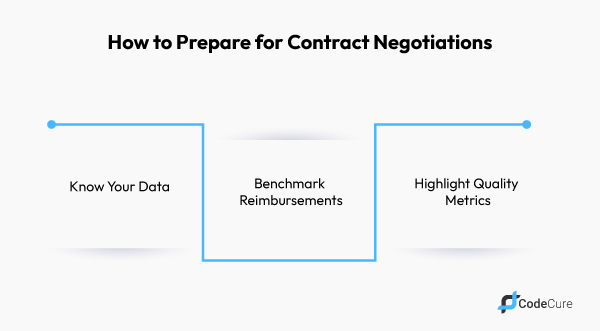
1. Know Your Data
Before entering any negotiation, understanding your practice’s financial performance is key. Review:
- Historical reimbursement rates from Medicare, Medicaid, and private payers
- Claim denial trends
- Patient volume and payer mix
- Quality metrics such as patient satisfaction and clinical outcomes
For example, in California, if your practice provides high-quality emergency services with low ED wait times, this data gives you leverage when negotiating with UnitedHealthcare or Aetna.
2. Benchmark Reimbursements
Compare your reimbursement rates with other local ER groups or similar practices in your state. For instance, providers in Texas, which has expanded Medicaid, may benefit from higher reimbursement rates due to the state’s Medicaid expansion.
Strategy:
Benchmark against local competitors and national averages to identify opportunities for better contract terms.
3. Highlight Quality Metrics
Value-based care continues to evolve, and private insurers and Medicare Advantage plans are increasingly rewarding providers for quality outcomes. Metrics like patient satisfaction, emergency department throughput, and readmission rates are essential for negotiating higher reimbursement rates.
How CodeCure Can Help ER Physician Groups
Contract negotiations, billing accuracy, and AR management can be overwhelming, but CodeCure is here to help. Here’s how we can support your ER practice:
1. Accurate Coding and Compliance
We ensure that your ER services are accurately coded, from room & board to ancillary services and physician consultations. With real-time updates on CMS regulations and payer-specific rules, we reduce denial rates and increase your first-pass claim acceptance rate.
2. AR Optimization
With proactive AR management, we help reduce days in AR and improve cash flow. Our team follows up on unpaid claims and handles appeals promptly to ensure your practice gets paid faster.
3. Denial Management and Appeals
We help you identify patterns in denied claims, develop appeals strategies, and make necessary corrections to improve reimbursement. Our denial management systems reduce administrative burden, allowing you to focus on patient care.
4. Payer Contract Support
CodeCure provides data insights to negotiate better rates with Medicare, Medicaid, UnitedHealthcare, Aetna, and Blue Cross Blue Shield. We give you the tools to leverage quality data and market positioning to secure the best possible contract terms.
Conclusion
Contract negotiations with Medicare, Medicaid, and private insurers are the backbone of a financially sustainable ER physician group. By preparing with data, quality metrics, and strong payer relationships, you can secure favorable reimbursement rates and contract terms that ensure your group thrives.
CodeCure can help your practice navigate the complexities of contract negotiations, AR management, and billing. Our team of experts ensures timely payments, compliance, and maximized reimbursements.
Ready to optimize your ER contract negotiations and increase reimbursement? Contact CodeCure today and let us help streamline your ER billing and financial processes.
FAQs
Why are contract negotiations critical for ER physician groups in 2026?
Contract negotiations directly impact reimbursement rates, cash flow, and long-term financial stability for ER physician groups. With Medicare reimbursement cuts, Medicaid underpayments, and tighter private payer contracts in 2026, poorly negotiated agreements can result in significant revenue loss and increased operational strain.
How do Medicare and Medicaid reimbursement rates affect ER physician revenue?
Medicare and Medicaid typically reimburse emergency services at lower rates than private insurers. For ER groups operating in Medicare- or Medicaid-heavy states like Florida, California, and Texas, these lower reimbursements often fail to cover the true cost of care, making strong private payer contracts essential to offset revenue gaps.
What challenges do ER physician groups face with out-of-network reimbursement?
Out-of-network ER services often lead to reduced payments from private insurers such as UnitedHealthcare, Aetna, and Blue Cross Blue Shield. This can cause balance billing issues, delayed payments, and revenue shortfalls. Securing in-network contracts helps stabilize reimbursement and improve patient satisfaction.
How can ER physician groups negotiate better rates with private insurers?
Successful negotiations rely on data. ER groups should leverage payer mix analysis, quality metrics (ED throughput, patient satisfaction, readmission rates), and benchmark reimbursement data. Demonstrating high-quality, efficient care strengthens negotiation leverage with private payers and Medicare Advantage plans.
What role does value-based care play in ER contract negotiations?
Value-based care models reward ER groups that demonstrate strong clinical outcomes and operational efficiency. Payers increasingly consider quality performance when setting reimbursement rates, especially in competitive markets like California and New York. Strong quality reporting can lead to higher negotiated rates.
How often should ER physician groups review payer contracts?
ER physician groups should review payer contracts annually and before renewal cycles. Changes to Medicare Physician Fee Schedules, Medicaid policies, or private payer terms can significantly impact revenue. Regular reviews help identify underperforming contracts and renegotiate unfavorable terms.
How can CodeCure help ER physician groups with payer contract negotiations?
CodeCure supports ER physician groups by aligning billing accuracy, denial management, AR optimization, and payer data insights. Our team helps practices identify revenue leakage, strengthen payer positioning, and negotiate more favorable contracts with Medicare, Medicaid, and major private insurers.