



If your healthcare practice is treating patients every day but payments are taking weeks or even months to arrive, you’re not alone. Rising claim denials, payer delays, staffing shortages, and increasing patient financial responsibility have made Accounts Receivable (AR) one of the biggest challenges for healthcare providers across the United States.
Reducing AR Days in medical billing is no longer just a financial goal it’s essential for maintaining healthy cash flow, minimizing write-offs, and ensuring long-term practice growth.
Reducing AR Days in medical billing requires accurate patient registration, insurance eligibility verification, clean claim submission, timely payer follow-up, proactive denial management, and efficient patient collections. High-performing healthcare organizations typically maintain fewer than 35–40 AR Days, although benchmarks vary by specialty and payer mix.
What Are AR Days in Medical Billing?
Accounts Receivable (AR) Days measure the average number of days it takes a healthcare provider to collect payment after services have been rendered and claims are submitted to insurance companies.
A lower AR Days figure generally indicates an efficient revenue cycle, while higher AR Days may signal billing errors, delayed follow-up, unresolved denials, or payer reimbursement issues.
AR Days Formula
AR Days = Total Accounts Receivable ÷ Average Daily Charges
Although performance varies by specialty, many revenue cycle experts recommend maintaining AR Days below 40 days for a financially healthy practice.
Healthcare AR Benchmarks
| Revenue Cycle KPI | Industry Benchmark |
|---|---|
| Average Days in Accounts Receivable | <35 Days (best practice) |
| AR Older Than 90 Days | <20% of Total AR |
| First-Pass Claim Denial Rate | <5% |
| Net Collection Rate | >97% |
| Appeal Success Rate | >75% |
Monitoring these key performance indicators helps healthcare organizations identify revenue bottlenecks before they impact profitability.
Why AR Days Are Increasing Across U.S. Healthcare Practices
Healthcare reimbursement has become increasingly complex. Frequent payer policy updates, stricter documentation requirements, staffing shortages, and rising patient deductibles have extended payment cycles for many providers.
Several industry trends continue to impact revenue cycle performance:
- Claim denials remain one of the leading causes of delayed reimbursement.
- Patient financial responsibility continues to increase due to higher deductibles and coinsurance.
- Prior authorization requirements are becoming more complex across many specialties.
- Manual billing processes often delay claim follow-up and appeals.
- Healthcare organizations are facing increased administrative workloads with fewer billing resources.
These challenges make proactive AR management more important than ever.
Common Causes of High AR Days
Most practices experience higher-than-average AR Days because of preventable operational issues, including:
- Incomplete insurance eligibility verification
- Missing prior authorizations
- Coding and documentation errors
- Delayed payer follow-up
- Slow denial resolution
- Inefficient patient collection processes
- Manual billing workflows
- Frequent payer policy changes
Addressing these root causes early helps reduce outstanding receivables and improve reimbursement timelines.
7 Proven Strategies to Reduce AR Days
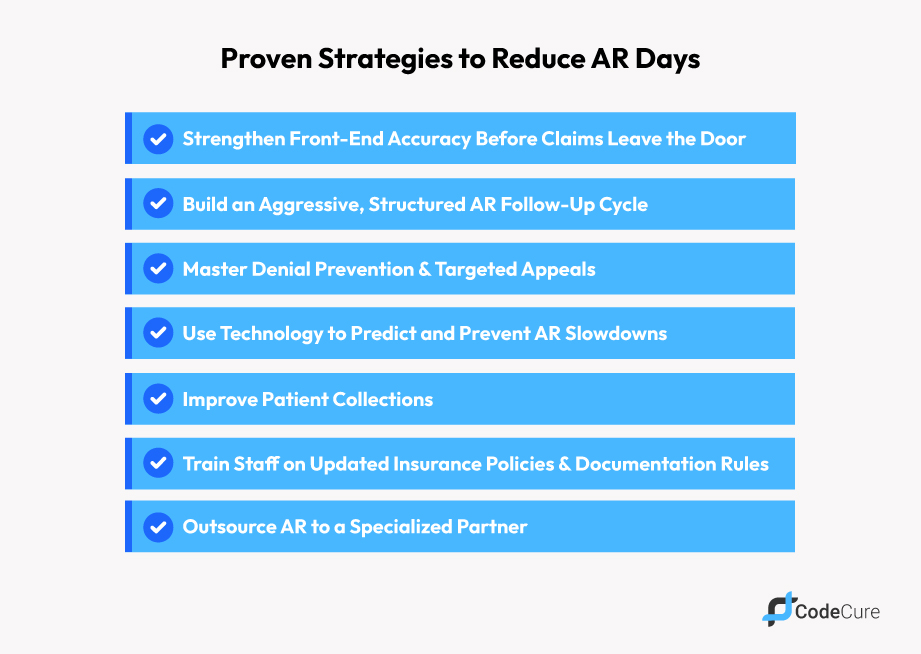
1. Improve Front-End Accuracy
Many billing issues begin before a claim is submitted. Accurate patient registration, insurance eligibility verification, prior authorization, and correct demographic information help prevent avoidable denials. Collecting copays and deductibles upfront also reduces patient accounts receivable.
2. Submit Clean Claims the First Time
Coding errors, missing modifiers, and incomplete documentation often lead to payment delays. Using certified medical coders, claim-scrubbing software, and standardized documentation improves first-pass claim acceptance and speeds reimbursement.
3. Strengthen AR Follow-Up
Successful practices don’t wait 30 days before checking claim status. Instead, they follow up within 48–72 hours, monitor aging reports regularly, and prioritize older accounts before they become difficult to recover. A structured follow-up process keeps claims moving through the reimbursement cycle.
4. Reduce Denials with Data-Driven Processes
Denial management services should focus on prevention as much as recovery. Track denial trends by payer, identify recurring issues, and correct them before they impact future claims. Timely appeals supported by complete documentation significantly improve reimbursement rates and reduce write-offs.
5. Automate Billing Workflows
Modern revenue cycle management relies on automation to improve efficiency. Automated eligibility verification, claim scrubbing, real-time dashboards, aging reports, and patient payment reminders help reduce manual work while improving claim accuracy and collection performance.
6. Improve Patient Collections
As patient financial responsibility continues to grow, practices need clear and convenient payment options. Providing cost estimates before visits, offering online payment portals, flexible payment plans, and easy-to-understand statements encourages faster patient payments and reduces outstanding balances.
7. Consider Specialized AR Management Support
When internal billing teams are overwhelmed, outsourcing AR management can accelerate collections and improve cash flow. Experienced AR specialists provide payer follow-up, denial resolution, aging account recovery, and reporting that helps practices recover revenue while allowing staff to focus on patient care.
Why Lower AR Days Matter
Organizations that consistently manage AR performance often experience faster reimbursements, fewer write-offs, improved cash flow, higher clean claim rates, and lower administrative costs. Maintaining strong AR metrics also allows practices to invest in staffing, technology, and patient care rather than spending additional resources on claim recovery. Learn more about the hidden cost of unworked A/R.
How CodeCure Helps Reduce AR Days
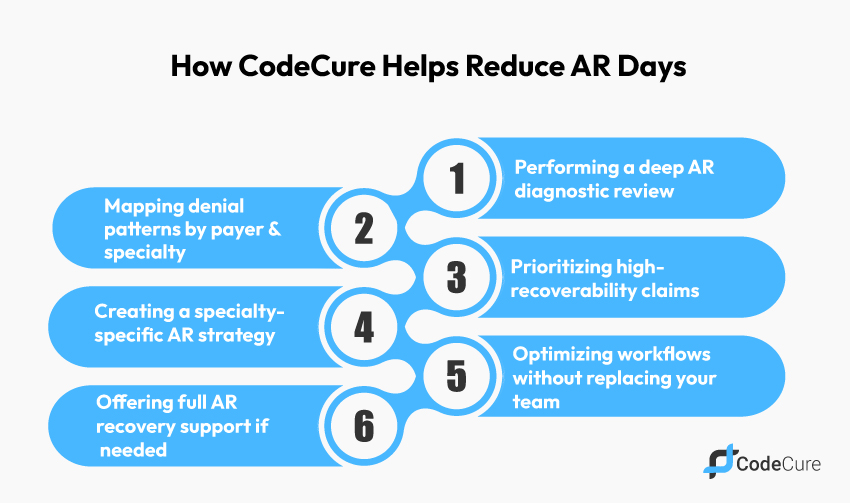
Wondering how much revenue is tied up in aging accounts? CodeCure’s AR specialists analyze your accounts receivable, identify denial trends, prioritize high-value claims, and recommend practical strategies to improve collections and reduce AR Days. Request an AR Optimization Review to uncover opportunities to strengthen cash flow and improve your revenue cycle performance.
Conclusion
Reducing AR Days in medical billing is one of the most effective ways to improve cash flow, increase collections, and strengthen long-term financial performance. By improving front-end accuracy, submitting clean claims, preventing denials, automating billing workflows, and optimizing patient collections, healthcare providers can build a healthier and more efficient revenue cycle.
If your practice is struggling with aging accounts or delayed reimbursements, a proactive AR optimization strategy can uncover hidden revenue opportunities and accelerate collections.
Ready to improve your cash flow? Contact CodeCure today for a comprehensive AR Optimization Review and discover how much recoverable revenue may be sitting in your accounts receivable.
FAQs
What is a good AR Days benchmark for a medical practice?
Most healthcare practices aim to maintain 30–40 AR Days for a healthy revenue cycle. However, the ideal benchmark depends on your specialty, payer mix, and claim volume. AR Days above 50 may indicate delays in claim processing, follow-up, or collections.
How do you calculate AR Days in medical billing?
AR Days are calculated using this formula:
AR Days = Total Accounts Receivable ÷ Average Daily Charges
This metric measures how long it takes your practice to collect payments after services are provided.
What causes high AR Days?
Common causes include insurance eligibility errors, claim denials, coding mistakes, missing prior authorizations, delayed payer follow-up, inefficient billing workflows, and increasing patient balances.
Can an AR management company recover old unpaid claims?
Yes. Experienced AR specialists review aging accounts, identify recoverable claims, resolve denials, correct billing errors, and follow up with insurance companies to maximize reimbursements before timely filing limits expire.
How does CodeCure help with AR optimization?
CodeCure analyzes your accounts receivable, identifies revenue bottlenecks, prioritizes recoverable claims, strengthens payer follow-up, reduces denials, and helps healthcare providers improve cash flow through data-driven AR optimization strategies.