


HCC V28 coding accuracy has become increasingly important for internal medicine practices participating in Medicare Advantage risk adjustment. The updated CMS-HCC model changes diagnosis mappings, condition categories, and RAF calculations, making accurate documentation and current coding workflows essential.
For internal medicine practices, the focus should be on accurately documenting conditions that are clinically supported, actively addressed, and coded to the appropriate level of specificity.
Quick Answer: Why Does HCC V28 Coding Accuracy Matter for Internal Medicine?
HCC V28 coding accuracy matters because internal medicine practices often manage patients with multiple chronic conditions. Accurate provider documentation helps ensure that clinically supported conditions are correctly represented in Medicare Advantage risk adjustment data.
The medical record should establish that:
- The condition exists
- The condition is current
- The provider evaluated or managed the condition
- The diagnosis is documented with appropriate specificity
A diagnosis appearing only on a problem list does not establish clinical validity. To improve HCC accuracy, compliance, and audit readiness, many internal medicine practices rely on specialized Internal Medicine coding services and medical billing services that support accurate documentation review, coding validation, and efficient risk adjustment workflows.
What Is CMS-HCC V28 Risk Adjustment?
The CMS-HCC model is a risk adjustment system developed by the Centers for Medicare & Medicaid Services (CMS) to estimate expected healthcare costs for Medicare Advantage beneficiaries.
The model considers factors such as:
- Patient demographics
- Diagnosed medical conditions
- Hierarchical Condition Categories (HCCs)
- Disease severity
- Disease interaction terms
These factors are used to calculate a Risk Adjustment Factor (RAF) score. Under V28, organizations must use the applicable CMS model software and ICD-10-CM mappings rather than relying on historical V24 assumptions.
Why Internal Medicine Practices Need Accurate HCC Documentation
Internal medicine providers frequently manage multiple chronic conditions during the same encounter, including:
- Type 2 diabetes
- Congestive heart failure
- Chronic kidney disease
- COPD
- Obesity
- Peripheral vascular disease
- Depression
A patient may have several clinically significant conditions at the same time. However, each condition must be supported by the current medical record.
For example, a patient may have diabetes with complications, CKD stage 3, chronic heart failure, and obesity. If the documentation does not clearly describe the conditions and their current management, coding may not accurately reflect the patient’s clinical status.
Why Provider Documentation Matters More Under V28
A diagnosis code does not independently establish clinical validity.
Weak documentation
CHF
Stronger documentation
Chronic systolic heart failure, stable on guideline-directed medication therapy. Symptoms reviewed and ongoing monitoring continued. The stronger documentation identifies the condition and provides evidence of current clinical management.
Major Changes From HCC V24 to V28
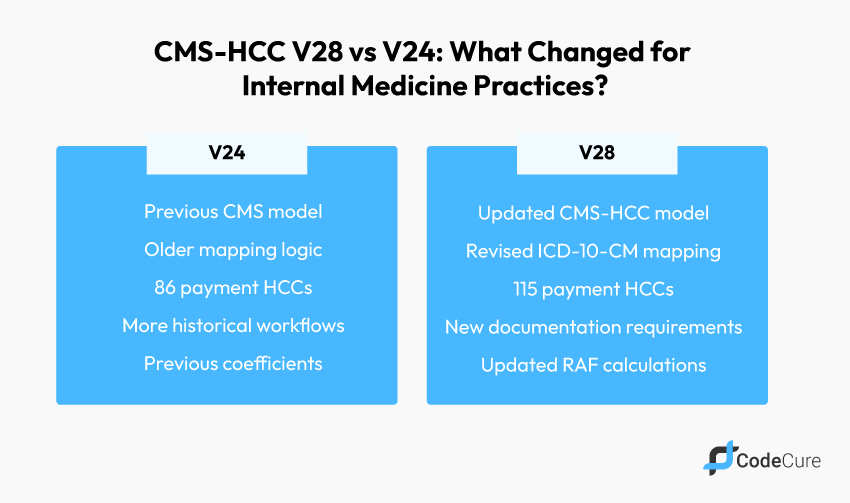
CMS-HCC V28 represents a substantial redesign of the risk adjustment model.
Key changes include:
| Area | V24 | V28 |
| Model structure | Previous CMS-HCC model | Updated CMS-HCC model |
| ICD-10 alignment | Earlier mapping logic | Refined ICD-10-CM alignment |
| Payment categories | 86 payment HCCs | 115 payment HCCs |
| Diagnosis mapping | Older crosswalk | Revised mappings |
| Documentation needs | Less specificity pressure | Greater specificity requirements |
Because mappings and payment categories changed, practices should not assume that a diagnosis that contributed under V24 will have the same impact under V28.
How HCC V28 Changes RAF Score Calculation
A patient’s RAF score is influenced by multiple components, including:
- Demographic factors
- Payment HCCs
- Disease interaction terms
- HCC count factors
One important operational issue is that some diagnoses that previously contributed under V24 may not have the same payment impact under V28.
Practices should therefore prioritize:
- Correct diagnosis selection
- Clinical specificity
- Current documentation
- Accurate mapping
Historical diagnosis lists should not be treated as automatic V28 coding instructions.
Do Disease Interaction Terms Still Count Under HCC V28?
Yes. Disease interaction terms can contribute to RAF calculations separately from hierarchy rules.
For example, diabetes and congestive heart failure may generate an interaction term even when hierarchy rules affect the individual HCC contribution. The article’s key operational point is that practices should understand both hierarchy logic and interaction terms rather than evaluating diagnoses individually.
HCC Hierarchy and Diagnosis Trumping Under CMS-HCC V28
The CMS-HCC model does not simply add every diagnosis together. Within related disease groups, hierarchy rules can cause a more severe condition to replace a less severe condition for risk adjustment purposes.
For example, a patient may have:
- CKD stage 3
- CKD stage 4
Both conditions may exist clinically, but the higher-severity condition generally represents the applicable higher category within the hierarchy.
Hierarchy suppression does not mean the lower condition was incorrectly documented. It means the model applies payment logic to avoid double-counting related severity levels.
HCC V28 Documentation Requirements: Why MEAT Matters
A commonly used framework for evaluating whether a diagnosis was actively addressed is MEAT:
- Monitor
- Evaluate
- Assess
- Treat
MEAT helps distinguish active clinical management from diagnoses that simply remain on a historical problem list.
MEAT Documentation Examples
| Condition | Weak Documentation | Strong Documentation |
| Heart Failure | CHF | Chronic systolic heart failure stable on medication therapy; symptoms reviewed and treatment continued |
| CKD | CKD | CKD stage 3b with renal function monitoring and medication review |
| Diabetes | Diabetes | Type 2 diabetes with A1c review and medication management |
| COPD | COPD stable | COPD symptoms assessed; inhaler therapy reviewed and continued |
Why Problem Lists Are Not Enough
Problem lists can contain conditions that are no longer actively evaluated or managed.
For example, a chart may list congestive heart failure while the current encounter contains:
- No assessment
- No symptom review
- No medication discussion
- No treatment plan
A stronger record connects:
Condition → Clinical evaluation → Provider assessment → Management plan
Common HCC V28 Coding Accuracy Problems in Internal Medicine
Internal medicine practices often experience HCC accuracy challenges because they manage large chronic disease populations.
The most common issues include:
1. Missing Disease Specificity
V28 places greater importance on precise documentation.
Examples:
Less Specific:
- Diabetes
- CKD
- Heart failure
More Specific:
- Type 2 diabetes with complications
- CKD stage 3b
- Chronic systolic heart failure
The more accurately the clinical condition is described, the better the diagnosis coding can represent the patient’s actual health status.
2. Copy-Forward Documentation Without Current Evaluation
Electronic health records make it easy to carry diagnoses forward year after year. However, repeated appearance of a condition does not automatically prove active management.
Example:
Previous year:
COPD documented
Current visit:
COPD appears only in the problem list
A stronger record would show:
- Current symptoms
- Medication review
- Disease status
- Treatment decisions
3. Using Outdated V24 Assumptions
A major operational challenge is continuing workflows built around the previous CMS-HCC model.
Under V28:
- Diagnosis mappings changed
- Condition categories changed
- Some codes no longer contribute the same way
- Documentation priorities shifted
CMS provides current model software and ICD-10-CM mappings for organizations to apply the appropriate model logic.
4. Focusing Only on Additional Diagnoses
Modern risk adjustment requires balance. A mature HCC program does not simply search for more diagnoses.
It evaluates:
Missed Supported Conditions
Example:
The medical record supports diabetes with complications, but coding reflects only uncomplicated diabetes.
Unsupported Conditions
Example:
A diagnosis appears in the chart but lacks current clinical support.
Accurate coding requires capturing valid conditions while removing unsupported ones.
Annual HCC Recapture Strategy for Internal Medicine Practices
One of the biggest operational challenges under Medicare Advantage risk adjustment is annual condition recapture.
Risk adjustment operates on a measurement-year basis.
A chronic condition documented in a previous year does not automatically continue contributing to future risk scores without appropriate current-year documentation.
How Internal Medicine Practices Can Build a V28 Recapture Workflow
Step 1: Review Previous-Year Conditions
Identify patients with previously documented chronic conditions:
- Diabetes
- CHF
- CKD
- COPD
- Vascular disease
- Other chronic illnesses
Step 2: Identify Upcoming Visits
Before scheduled appointments:
- Review previous diagnoses
- Identify documentation opportunities
- Prepare clinical summaries
Step 3: Support Provider Documentation
During the encounter, providers should:
- Confirm active conditions
- Document disease status
- Address treatment plans
- Capture necessary specificity
Step 4: Validate Coding Before Submission
Review:
- ICD-10 accuracy
- HCC mapping
- Documentation support
- Hierarchy rules
Step 5: Monitor Recapture Performance
Track:
- HCC recapture rate
- Provider trends
- Documentation gaps
- Audit findings
HCC V28 Audit Strategies for Internal Medicine Practices
A strong audit program is essential because V28 requires organizations to verify both accuracy and compliance.
An effective audit should answer two questions:
- Are valid clinical conditions being captured?
- Are submitted diagnoses supported by medical documentation?
Strategy 1: Audit Using Current V28 Mapping Logic
Internal medicine groups should ensure:
- Coding tools use current mappings
- Reports reflect V28 categories
- Education materials are updated
- Analytics dashboards use current model rules
Using historical V24 assumptions can create inaccurate conclusions about performance.
Strategy 2: Validate Documentation Before Reviewing RAF Opportunities
A diagnosis mapping does not automatically mean a diagnosis should be reported.
The correct workflow is:
Medical record review
↓
Clinical support verification
↓
ICD-10-CM selection
↓
HCC mapping
↓
RAF calculation
Strategy 3: Review Both Under-Coding and Over-Coding
A balanced audit evaluates both sides.
Under-Coding
Examples:
- Missing CKD stage
- Missing documented complications
- Incomplete heart failure classification
Over-Coding
Examples:
- Historical conditions documented as active
- Problem-list-only diagnoses
- Unsupported severity levels
Strategy 4: Segment Audit Results
Overall accuracy percentages can hide important problems.
Analyze findings by:
- Provider
- Specialty
- Disease category
- Location
- Coding team
- Documentation issue
Example:
If one provider group consistently documents CKD without staging, the solution may require targeted education rather than broad coding changes.
Strategy 5: Turn Audit Findings Into Improvement Actions
An audit should create measurable improvement.
Actions may include:
- Provider education
- CDI training
- Template updates
- Coding guideline updates
- Workflow improvements
- Follow-up audits
HCC V28 and RADV Audit Readiness
Risk Adjustment Data Validation (RADV) audits evaluate whether submitted diagnoses are supported by medical records.
Internal medicine organizations should maintain:
- Complete encounter documentation
- ICD-10 coding rationale
- Review records
- Audit trails
- Corrective action history
Audit readiness should be incorporated into the HCC workflow rather than addressed only after an audit request.
How AI and Analytics Can Support HCC V28 Accuracy
Technology can help organizations manage large populations and prioritize chart reviews.
Potential applications include:
- Identifying documentation gaps
- Prioritizing complex patient charts
- Detecting documentation inconsistencies
- Tracking provider-level trends
AI and analytics should support qualified clinical and coding review rather than replace professional judgment.
HCC V28 Coding Accuracy Checklist for Internal Medicine
Before submitting risk adjustment data, organizations should confirm:
- Current CMS-HCC V28 model applied
- Updated ICD-10-CM mappings used
- Diagnoses supported by medical records
- Chronic conditions actively addressed
- MEAT evidence documented
- Disease specificity captured
- Hierarchy rules reviewed
- Interaction terms evaluated correctly
- Unsupported diagnoses removed
- Audit documentation maintained
Conclusion:
HCC V28 requires internal medicine practices to move beyond simply carrying forward diagnoses. Accurate risk adjustment depends on current clinical documentation, appropriate ICD-10-CM coding, correct HCC mapping, and defensible review processes.
A strong HCC workflow connects provider documentation, coding accuracy, annual recapture, hierarchy logic, and audit readiness while ensuring that reported diagnoses accurately reflect the patient’s documented clinical condition.
Schedule an appointment with our experts to review your current documentation and risk adjustment process.