


A simple coding mistake in orthopedic billing can cost more than a delayed payment; it can trigger denials, audits, and unexpected revenue loss. Even something as routine as CPT 27447 for total knee replacement can become problematic when paired with incorrect modifiers like 59 or 78 or when documentation does not fully support the service.
Orthopedic billing is complex by nature, involving global surgical packages, multi-site procedures, and tightly linked CPT and ICD-10 codes. Because of this, even small documentation gaps can quickly turn into claim rejections or underpayments.
As payer rules continue to evolve in 2026, accuracy in coding is no longer optional; it is essential for protecting revenue and maintaining compliance. This guide breaks down the key orthopedic coding rules in a simple, practical way to reduce errors and improve reimbursement.
Orthopedic Coding Cheat Sheet 2026: Understanding Orthopedic Procedures
Before assigning any CPT code, it is essential to correctly understand the orthopedic procedure itself. Most coding errors begin at the interpretation stage, not during claim submission. If the procedure is misidentified, every downstream code will be incorrect.
In orthopedic billing, accuracy depends on how well coders translate surgical documentation into standardized coding language. This requires understanding not just the procedure name, but also the clinical intent, anatomical site, and surgical approach.
Key Elements to Identify Before Coding
- Procedure type identification
Determine whether the service is a repair, reconstruction, replacement, or removal. This step defines the entire CPT coding category and prevents the selection of an incorrect code family. - Surgical approach recognition
Identify whether the procedure was performed open, arthroscopically, or percutaneously. Even the same anatomical procedure can have completely different CPT codes based on the approach. - Anatomical precision and laterality
Confirm the exact joint, bone, or soft tissue involved, along with right or left side specification. Missing laterality often leads to claim rejection or medical necessity mismatch. - Complexity and procedural variation
Evaluate whether additional factors such as grafting, instrumentation, or multiple compartments were involved, as these directly impact code selection and modifier usage.
Key Orthopedic Surgeries and How They Are Coded
Orthopedic practices manage a wide spectrum of procedures ranging from simple injections to highly complex reconstructive surgeries. Each category carries unique coding rules, bundling risks, and documentation requirements that directly affect reimbursement accuracy.
Understanding these procedures in grouped categories helps coders apply CPT codes more consistently and avoid common errors such as unbundling, incorrect approach selection, or missing modifiers.
-
Total Joint Replacements
Joint replacement procedures are high-value, global-package surgeries that require strict documentation alignment between procedure details and diagnosis codes.
- Total Knee Arthroplasty (TKA) – CPT 27447
Complete replacement of the knee joint, typically performed for severe osteoarthritis. Includes pre-op planning and post-op care under global surgical rules. - Total Hip Arthroplasty (THA) – CPT 27130
Hip joint replacement procedure requires precise documentation of degenerative disease, surgical approach, and implant usage.
These procedures often involve bundled services, meaning coders must carefully avoid billing separately for services already included in the global package.
-
Fracture Repair and Fixation
Fracture management coding varies based on fracture type, severity, and fixation method, making documentation clarity essential.
- Distal Radius ORIF – CPT 25607–25609
Code selection depends on the complexity of fracture repair and whether internal fixation devices were used. - Metacarpal Fracture Fixation – CPT 26615
Requires clear operative documentation of hardware placement and fracture stabilization. - Bimalleolar Ankle Fracture Repair – CPT 27758
Complex fracture repair involving both malleoli often requires detailed imaging and surgical notes.
Coding errors in this category commonly occur due to an unclear distinction between simple and complex fracture repair.
-
Spine Procedures
Spine surgery coding is highly sensitive due to multiple vertebral levels, instrumentation requirements, and surgical approach variations.
- Laminectomy – CPT 63030
Decompression procedure requiring documentation of the exact spinal level. - Lumbar Fusion – CPT 22630–22840
Complex procedure involving fusion of vertebrae, often combined with instrumentation.
Proper coding depends heavily on detailed operative reports specifying levels, approach, and hardware used.
-
Arthroscopic Procedures
Arthroscopy procedures are minimally invasive but highly prone to bundling issues under NCCI edits.
- Knee Arthroscopy with Meniscectomy – CPT 29881
Removal of damaged meniscus tissue is often bundled with other knee procedures. - Shoulder Arthroscopy with Rotator Cuff Repair – CPT 29827
Requires precise documentation of tendon involvement and repair technique.
These procedures must be carefully reviewed to avoid unbundling errors that can trigger denials.
-
Tendon and Ligament Repairs
These procedures vary significantly based on severity, chronicity, and the repair technique used.
- ACL Reconstruction – CPT 29888
Requires documentation of graft use and reconstruction method. - Achilles Tendon Repair – CPT 27650
Coding depends on whether the tear is acute or chronic and whether reinforcement was performed.
Anatomy-Based Coding Essentials in Orthopedics
Accurate orthopedic coding depends heavily on how well the human anatomy is interpreted within clinical documentation. Even when the correct procedure is performed, misreading anatomical details can lead to incorrect CPT selection or diagnosis mismatch.
This section focuses on how anatomical specificity directly influences coding accuracy, modifier selection, and claim approval rates.
-
Laterality and Side-Specific Coding
Laterality is one of the most critical components in orthopedic coding and is frequently overlooked.
- Right vs Left Identification
Every joint or bone must clearly indicate whether the procedure was performed on the right or left side. Missing laterality often leads to claim rejection or payer correction requests. - ICD-10 dependency on laterality
Many diagnosis codes change based on side (e.g., right knee osteoarthritis vs left knee osteoarthritis), making alignment essential. - Modifier alignment (RT/LT)
CPT codes must match operative documentation and be supported with correct side-specific modifiers when required.
-
Joint and Structure Identification
Orthopedic procedures often involve multiple joints and structures, making precise identification essential.
- Major joint recognition
Coders must correctly identify joints such as the knee, hip, shoulder, ankle, and elbow to avoid CPT mismatches. - Deep anatomical terminology
Terms like glenohumeral, tibiotalar, and femoroacetabular joints must be interpreted correctly from operative notes. - Multi-joint procedures
When more than one joint is involved, each service must be separately validated for coding eligibility.
-
Tissue-Level Coding Accuracy
Different orthopedic procedures target different tissues, and this distinction directly affects CPT selection.
- Bone-related procedures
Fracture repairs and osteotomies involve bone-level coding rules and often require fixation reporting. - Soft tissue procedures
Tendons, ligaments, and muscles require different CPT families compared to bone procedures. - Cartilage and meniscus repairs
These are frequently involved in arthroscopic procedures and are commonly bundled under NCCI edits.
-
Surgical Approach and Technique Differences
The surgical approach plays a major role in determining the correct CPT code, even for identical anatomical sites.
- Open procedures
Require separate CPT codes compared to minimally invasive approaches and often involve longer recovery coding considerations. - Arthroscopic procedures
Minimally invasive but highly bundled; require strict review of included services. - Percutaneous techniques
Often used in injections or fracture fixation and follow distinct coding rules.
Orthopedic CPT Code Reference Guide for 2026
This section organizes commonly used orthopedic CPT codes into a structured table format for faster reference, improved accuracy, and easier coding workflow integration. Proper CPT selection should always align with operative documentation and payer-specific guidelines.
CPT Code Reference Table
| Category | CPT Code | Procedure Description | Coding Notes |
| Joint Replacement | 27447 | Total Knee Arthroplasty (TKA) | Global surgical package; ensure OA diagnosis support and laterality accuracy |
| 27130 | Total Hip Arthroplasty (THA) | Requires documentation of approach and implant details | |
| 23472 | Total Shoulder Arthroplasty | High-complexity procedure often bundled with perioperative services | |
| Fracture Treatment | 25607 | Distal radius ORIF (extra-articular) | Depends on fracture complexity and fixation method |
| 26615 | Metacarpal fracture fixation | Requires hardware documentation (plates/screws/pins) | |
| 27758 | Bimalleolar ankle fracture repair | Complex fracture involving both malleoli | |
| Arthroscopy | 29881 | Knee arthroscopy with meniscectomy | Frequently bundled under NCCI edits |
| 29827 | Shoulder arthroscopy rotator cuff repair | Requires clear tendon repair documentation | |
| 29888 | ACL reconstruction | Must document graft type and reconstruction method | |
| Spine Procedures | 63030 | Lumbar laminectomy | Requires exact spinal level documentation |
| 22630 | Lumbar fusion (single level) | Often combined with instrumentation coding | |
| 22842 | Spinal instrumentation (segmental) | Used with fusion procedures for hardware reporting | |
| Tendon & Ligament Repair | 27650 | Achilles tendon repair | Depends on acute vs chronic injury status |
| 23410 | Open rotator cuff repair (acute) | Open approach for recent injury | |
| 23412 | Open rotator cuff repair (chronic) | Used for degenerative or long-standing tears | |
| Injection / Aspiration | 20610 | Major joint injection/aspiration | Knee, shoulder, and hip are commonly included |
| 20605 | Intermediate joint injection/aspiration | Elbow, wrist, ankle procedures |
Code Selection Rules and Billing Guidelines
Accurate CPT selection in orthopedics depends on matching operative documentation with correct coding rules. Even small mismatches can lead to denials, underpayments, or compliance issues.
Core Coding Rules
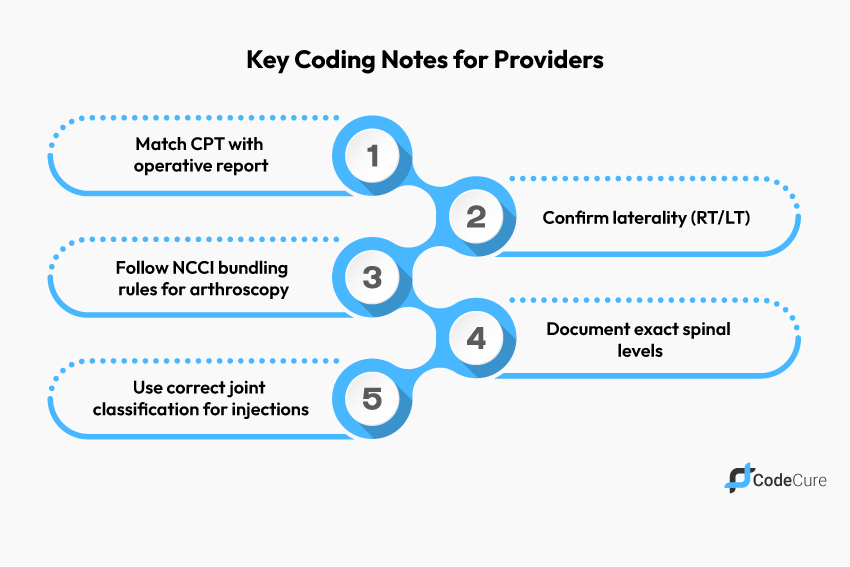
- Match CPT with operative report
Code only what is clearly documented in the final surgical note, not the schedule or intent. - Confirm surgical approach
Verify open, arthroscopic, or percutaneous technique before selecting CPT. - Check laterality
Ensure right, left, or bilateral details are correctly documented and coded. - Avoid assumption-based coding
Never infer missing details, code only what is explicitly written.
Bundling and Compliance Rules
- Check NCCI edits before billing separately
Many orthopedic procedures include bundled components. - Do not unbundle services
Separate billing without justification leads to denials or audits. - Use modifiers only when supported
Modifiers like 59 should reflect truly distinct procedures.
Modifier Essentials
- Modifier 22 → Only for clearly increased complexity
- Modifier 50 → Bilateral procedures in one session
- RT/LT → Side-specific coding when required
- Modifiers 58/78/79 → Used for global period scenarios only
Pre-Submission Checklist
- CPT matches operative report
- ICD-10 supports medical necessity
- Modifiers are correctly applied
- No NCCI conflicts exist
- Payer rules are verified
Following these rules helps reduce denials, improve clean claim rates, and ensure consistent reimbursement across orthopedic services.
ICD-10 Codes and Their Application
ICD-10 codes play a critical role in supporting medical necessity and ensuring CPT codes are properly justified. Incorrect or non-specific diagnosis coding is one of the most common causes of orthopedic claim denials.
| Category | ICD-10 Code | Description | Coding Notes |
| Osteoarthritis | M17.11 | Right knee osteoarthritis | Common indication for TKA procedures |
| M16.12 | Left hip osteoarthritis | Supports hip replacement claims | |
| Fractures | S52.501A | Right radius fracture (initial) | Must include encounter type (A, D, S) |
| S82.202A | Left tibia fracture (initial) | Laterality is required for accuracy | |
| Tendon/Ligament Injuries | S83.511A | ACL sprain, right knee | Common sports-related injury code |
| S86.011A | Achilles tendon strain | Requires injury encounter classification | |
| Spine Conditions | M48.061 | Lumbar spinal stenosis | Often supports decompression procedures |
| M51.26 | Lumbar disc displacement | Common for spine surgery cases | |
| Postoperative Complications | T84.84XA | Pain due to prosthetic device | Implant-related complication code |
| T81.40XA | Post-surgical infection | Requires encounter-specific coding |
Modifiers and Their Correct Usage
Modifiers explain special circumstances in orthopedic procedures. Incorrect use is a major cause of denials, so documentation support is essential.
| Modifier | Meaning | Use Case |
| 59 | Distinct service | Different site or separate procedure |
| 22 | Increased service | Extra complexity or time |
| 50 | Bilateral | Same procedure on both sides |
| RT/LT | Right/Left | Side-specific procedures |
| 58 | Staged procedure | Planned follow-up surgery |
| 78 | Unplanned return | Related complication surgery |
| 79 | Unrelated procedure | Different conditions in global period |
| 76 | Repeat (same provider) | Same procedure repeated |
| 77 | Repeat (different provider) | Another provider repeats procedure |
Common Pitfalls and Prevention in Orthopedic Coding
Orthopedic billing errors often occur due to documentation gaps, incorrect code selection, or improper modifier use. These mistakes directly impact reimbursement and increase audit risk.
Common Coding Pitfalls
- Incorrect CPT selection
Using open vs arthroscopic codes incorrectly leads to denials or claim mismatch. - Missing or incorrect modifiers
Failure to apply RT/LT, 59, or 50 can result in underpayment or bundling issues. - Unbundling procedures
Separating services already included under NCCI edits triggers claim rejections. - Non-specific ICD-10 codes
Using unspecified diagnoses reduces medical necessity strength and increases audit risk. - Global period violations
Billing during the post-op period without proper modifiers (58/78/79) leads to denials.
Prevention Strategies
- Conduct regular chart and operative note audits
- Use coding checklists before claim submission
- Apply front-end claim scrubbing tools
- Train staff on orthopedic-specific coding rules
- Monitor denial trends for recurring issues
Avoiding these errors improves clean claim rates, reduces denials, and strengthens overall revenue cycle performance for orthopedic practices.
How CodeCure Helps Orthopedic Practices
Orthopedic billing is highly complex due to frequent CPT updates, strict modifier rules, and payer-specific requirements. CodeCure helps practices simplify this process by ensuring accurate CPT and ICD-10 coding, proper modifier usage, and strong documentation alignment to reduce claim errors and denials. With a focus on compliance and revenue integrity, CodeCure improves clean claim rates, reduces AR delays, and strengthens overall financial performance.
Conclusion
Accurate orthopedic coding is essential for protecting revenue, reducing denials, and maintaining compliance in 2026. When coding rules, modifiers, and documentation are handled correctly, practices can significantly improve reimbursement outcomes and operational efficiency.
If you’re looking to reduce denials, improve coding accuracy, and streamline your orthopedic revenue cycle, CodeCure can help. Get in touch today to optimize your billing performance and secure consistent revenue growth.
FAQs
1. What are the most common coding mistakes in orthopedic billing?
The most common errors include incorrect CPT code selection, missing laterality, improper modifier usage, unbundling services that are subject to NCCI edits, and linking procedures to unsupported ICD-10 diagnosis codes. These mistakes often result in denials, underpayments, and compliance concerns.
2. When should Modifier 59 be used in orthopedic coding?
Modifier 59 should only be used when procedures that are normally bundled are performed as distinct services at different anatomical sites, separate encounters, or different operative sessions. Documentation must clearly support the distinction to avoid audit risk.
3. How can orthopedic practices reduce claim denials?
Practices can reduce denials by verifying insurance eligibility, obtaining prior authorizations, ensuring accurate CPT and ICD-10 coding, applying modifiers correctly, reviewing NCCI edits, and conducting regular coding audits before claims are submitted.
4. Why is documentation so important in orthopedic coding?
Documentation serves as the foundation for code selection and medical necessity. Operative reports should clearly describe the procedure performed, surgical approach, laterality, diagnosis, implants used, and any unusual complexity to support accurate reimbursement.
5. How do global surgical periods affect orthopedic billing?
Many orthopedic procedures include a global period that covers routine post-operative care. Billing additional services during this period may require modifiers such as 58, 78, or 79, depending on whether the service is staged, related, or unrelated to the original procedure.
6. What should providers document to support accurate orthopedic coding?
Providers should document the exact procedure performed, anatomical location, laterality, surgical approach (open vs. arthroscopic), diagnosis, implant or hardware usage, and any complications or increased procedural complexity. Clear documentation helps prevent coding errors and claim disputes.
7. Is outsourcing orthopedic billing and coding worth it?
For many practices, outsourcing can improve coding accuracy, reduce denials, strengthen compliance, and free up staff to focus on patient care. Specialized orthopedic billing teams are often better equipped to manage complex coding rules, payer requirements, and revenue cycle challenges.